Outracing the Heat, One Lap at a Time
- David Ferguson, Ph.D.
- Associate Professor, Department of Kinesiology
- College of Education
Project Overview
- David Ferguson works with professional race car drivers to study extreme heat experienced during races and find solutions to keep them cool and safe while optimizing performance.
Products/Outcomes
- Data collection and real-time testing to validate research findings.
- Data-driven recommendations for cooling elements to assist racing sanctioning bodies in putting procedures and policies in place for safe racing.
Partners
- FluidLogic
- Formula 1
- Givaudan
- IndyCar
- Charlie Kimball
- Mercedes Grand Prix Limited
- NASCAR
- Mike Reid, University of Florida
- Jordan Taylor
- Ricky Taylor
- Wayne Taylor Racing
Form(s) of Engagement
- Community-Engaged Research
- Community-Engaged Teaching

David Ferguson stands in the NASCAR garage area ahead of a Cup Series race.
For David Ferguson, an associate professor with the Department of Kinesiology who has spent years alongside a racetrack, the appeal of motorsports goes beyond top speeds, tight turns, and winning races. While these elements are central to racing, Ferguson’s research has focused on another critical component: the driver.
These athletes spend their careers perfecting their skills to win races, but it’s equally important to consider what’s happening inside the vehicle during a race. With cockpit temperatures reaching upwards of 130 degrees Fahrenheit, Ferguson’s work centers on understanding how extreme heat affects drivers’ health and performance while still recognizing the need for speed.
Ferguson’s road to studying race car driver well-being began when he was 19 years old. He had long been interested in mechanics and “going fast,” which coupled well with racing, and led him to competing in a race in his hometown of Las Vegas where summer temperatures can reach 115 degrees. Following the race, he congratulated a fellow competitor on finishing in second place and was met with confusion from the driver who claimed to have finished fourth. Ferguson realized that the driver was so overheated and dehydrated, he was seeing double.
It was then that he recognized that motorsports teams, including NASCAR, Formula 1, and Le Mans (endurance races), while deeply concerned with automotive performance, were less focused on the health and physical limits of drivers inside the vehicles.
Ferguson’s research has revolved around understanding how extreme conditions like high cockpit temperatures, fatigue, and g-force affect drivers, areas where research has been limited. In fact, to date, fewer than 50 papers have been published focusing on how drivers’ bodies react to heat stress. Many were written by Ferguson, who says he’s fortunate to be a leader in driving this sort of work.
What Is Heat Stress?
Heat stress occurs when the body’s core temperature rises beyond the body’s ability to cool itself. For drivers, every movement required to control the car contributes to internal heat production, while protective equipment limits the body’s primary cooling mechanism. As core temperatures climb, heat stress can impair reaction time, decision-making, and muscular endurance, contributing to performance decline and safety risk over the course of a race.
“Operating the clutch, brake, accelerator, and steering wheel all generate metabolic heat,” Ferguson said. “However, the sweat produced isn’t going to evaporate because drivers are wearing fire protective suits, so they’re just going to keep sweating more and more. In fact, drivers can lose up to 7 pounds of sweat during a race.”
Each turn of the steering wheel requires 8 pounds of force. Pushing the brake takes 50 pounds of force. In NASCAR races alone, there are four corners to each lap, and 200 laps. That amounts to 800 instances where a driver must exude power to maintain position and speed, generating an exorbitant amount of metabolic heat.
“This is a great illustration of physiology,” Ferguson said. “When drivers get overheated, they start to comment on how the race car is handling. Because they can’t generate the strength to add pressure to the brake or steer the wheel, it indicates they’re getting fatigued and performance will start to decline. That could ultimately lead to spinning out or crashing.”
Connecting with the Racing Community
It’s no coincidence that individual drivers, teams, and racing sanctioning bodies, the organizations responsible for setting rules and overseeing competition, sought Ferguson’s expertise. Ferguson, who began his research on heat stress in 2007, is well known within the racing community not only for his published papers, but for his work with IndyCar driver Charlie Kimball, which began in 2011. Kimball has type 1 diabetes and was initially told his diagnosis would hinder his driving performance. Ferguson and Kimball worked together for 10 years to develop policies and practices that would optimize Kimball’s performance.
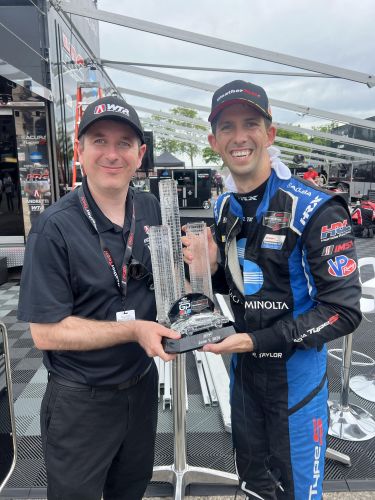
Ferguson poses with Ricky Taylor following Taylor’s first-place finish at the 2024 International Motorsports Association Chevrolet Detroit Grand Prix.
Ferguson’s reputation for using his knowledge to help cool drivers and enhance their health, while ensuring they still went fast, spread quickly across racing’s tight-knit community.
Then something happened in racing that propelled his research further into the spotlight. 2015 brought an increase in homologation, or standardization, meaning all cars needed to be similar as a cost-saving measure to ensure fair racing. One team couldn’t outrace its competitors by pouring millions of dollars into customization.
“In the past, race teams would build their own cars and could include cooling elements like fans and hoses, but when NASCAR opted for homologated cars, that meant customizing the cars for cooling was restricted,” Ferguson said.
Shortly after the announcement, Ferguson began working with the Wayne Taylor Racing (WTR) Team, led by endurance racing legend Wayne Taylor. His sons, Ricky and Jordan, compete with WTR in endurance and sports car racing. “The team has always been interested in driver physiology—driver science—and have made an excellent collaborative partner where I’m allowed to conduct research and study their drivers to help them be healthier and perform better,” Ferguson told MSUToday.
In his lab at MSU, Ferguson works with the Taylor brothers to simulate driving scenarios in order to understand how their bodies react during a race.

The Taylor brothers utilize the race car simulator in Ferguson’s lab to optimize performance and safety.
“Drivers are one of the least studied parts of motorsports,” Ricky told MSUToday. “We race anything from 100-minute races to 24-hour splits between two to four drivers. And sports car racing is unique in that you’re not only racing for a long period of time, but also the cars are quite hot inside.”
His brother Jordan added, “As a race car driver, you don’t get a lot of data on yourself, so it’s nice for us to work with Dr. Ferguson. Through tests, we learn a lot about ourselves and how we can improve ourselves as athletes, both outside the car and inside the car. Race cars have a lot of sensors on them and a lot of research and data that goes into making them go faster. But drivers don’t have that data. So, we go to Dr. Ferguson’s lab and correlate what we feel in the race car, on a treadmill, on a simulator, on a bike, and he can kind of direct us in a way that makes us feel better in our day jobs.”
Ferguson highlighted the importance of collaboration between research and driver experience, noting, “The best tool I can give them is information to optimize and maintain a very long career.”
Concerns Surrounding Heat Stress Intensify
In 2021-22, criticisms about heat grew within the racing community with the introduction of the Next Gen Car, NASCAR’s current generation of race car. Drivers were wary of this move, as they felt the newer cars were even hotter. Subsequently, NASCAR collaborated with Ferguson to collect data on drivers’ body temperatures.
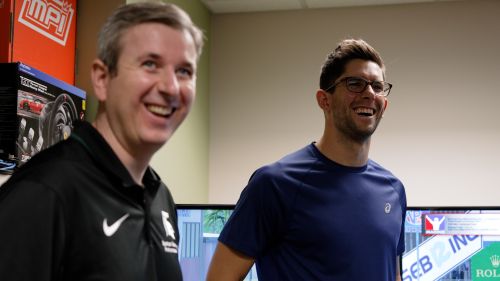
Ferguson and Jordan Taylor collaborate in Ferguson’s MSU lab to simulate what professional drivers experience during endurance races.
In 2023, Ferguson became the first researcher to receive a NASCAR-funded grant to study heat exhaustion and how drivers respond to heat stress in cars.
“When we came into the mix, drivers were somewhat standoffish,” Ferguson said. “But once they saw what we were doing to document the heat in the car to find solutions, they welcomed us.”
In the first year of the grant, Ferguson and his students accompanied teams and drivers to 11 different races collecting data. They measured body temperatures, sweat rate, and cooling capacities, and considered options that would prevent heat stress moving forward.
As the drivers became more comfortable with the “MSU kids,” as Ferguson and his students were affectionately known, they started pinpointing when and where they were feeling hot, even asking the team to go to certain races and racetracks.
Research in Motion
On race day, Ferguson is in the pits alongside the crew, functioning as part of the team. “We meet with the drivers, put the equipment on them, get them set up, and start data collection,” Ferguson said. “We’re watching the race, documenting what happens, and measuring weather influences like air temperature, wind speed and direction, and humidity.”
Currently, Ferguson is using a Bio-Harness and the Equivital Life Monitor system, covered in a fire-resistant synthetic fiber, to measure drivers’ heart rate, breathing rate, skin temperature, and the g-forces they’re exposed to. Ferguson explained they’re also testing the idea of using an ingestible sensor that looks like a multivitamin and monitors body temperatures with a Bluetooth signal.
Ferguson and his team are now testing new technology, including a sensor in the drivers’ radio earpiece. “That’s where we’re at now,” he said. “Working to refine and validate technology. It works really well in the lab, but when you get to the track, that’s where the real testing begins.”
Having spent his career working alongside professional drivers—from NASCAR to endurance racers—collecting data, listening to their concerns, and working together toward solutions, Ferguson has fulfilled a lifelong dream. “It’s a real honor,” he said. “This is what I wanted to do with my career, and I get to do it. I’m grateful for it every day, and I’m going to enjoy the moments while they last.”
- Written by Emily Springer, University Outreach and Engagement
- Photographs courtesy of David Ferguson and Garret Morgan