Imagining a Greener Detroit Through Ecology and the Arts
- Asia Dowtin, Ph.D.
- Associate Professor, Department of Forestry
- College of Agriculture and Natural Resources
- Estrella Torrez, Ph.D.
- Professor, Residential College in the Arts and Humanities
Project Overview
- A collaboration between MSU professors and a Detroit teacher brought together students from MSU and high schools in Detroit and Costa Rica to explore ecological issues through a lens of science and the arts, guided by their teachers and Detroit artists.
Products/Outcomes
- Zines with photos, poetry, and reflections from students and teachers about what they learned and their visions for reforesting Detroit.
- Student-created models illustrating ideas about how to reimagine and redevelop neighborhoods in decline, with a soundscape.
- Student-created art exhibition depicting impacts of pollution on water and land.
- Detroit high school students learned about career pathways in ecology and the arts, including urban forestry.
- MSU students gained experiential education about community engagement.
Partners
- Centro Cultural RioChante, Costa Rica
- Colegio Técnico Profesional de Santa Elena, Monteverde, Costa Rica
- Meg Heeres, visual artist
- Will “The Poet” Langford
- Heidi Quick, Ed.D., University Prep High School
- rocket(!!!)man, an audio experimentalist
Form(s) of Engagement
- Community-Engaged Creative Activity
- Community-Engaged Teaching and Learning
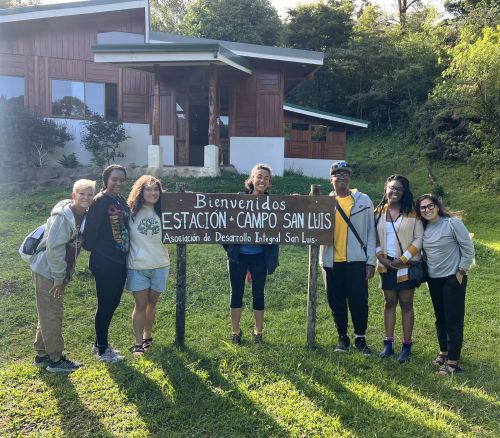
University Prep teacher Heidi Quick (far left) and MSU professors Asia Dowtin and Estrella Torrez (far right) brought students to Costa Rica to collaborate with their peers.
Dear Detroit,
You are like a flower.
When I think about my city, I feel warm.
If I could talk to you, I would tell you your worth.
—A poem by a University Prep student
Through poetry, sound, visual artwork, and spoken word, Detroit high school students worked alongside MSU students to envision a new urban landscape for their city as part of a project that merged the arts and environmental science.
In addition to making art together, students researched microplastics and macroplastics in the Great Lakes, traveled to Costa Rica to study with peers about the impact of pollution on the land, and worked with Detroit artists to demonstrate their knowledge and give creative voice to their hopes for a greener future for their city.
It was all part of the Green New DEAL (Detroit Ecological Arts Leaders), an interdisciplinary collaboration between Asia Dowtin, an associate professor with MSU’s Department of Forestry; Estrella Torrez, a professor with the Residential College in the Arts and Humanities (RCAH); and Heidi Quick, a teacher at University Prep Art and Design High School in Detroit.
Over the course of two academic years, the Green New DEAL paired RCAH students with Detroit high schoolers for an exploration of ecology through the lens of science and the arts.
The project arose from a collaboration begun in 2019 when Dowtin participated in conversations in Detroit about ways to encourage city residents to consider careers in urban natural resources. Through those talks, Dowtin connected with Quick, who at that time taught at University Prep Science and Math and had been working to create an urban ecology pathway program there.
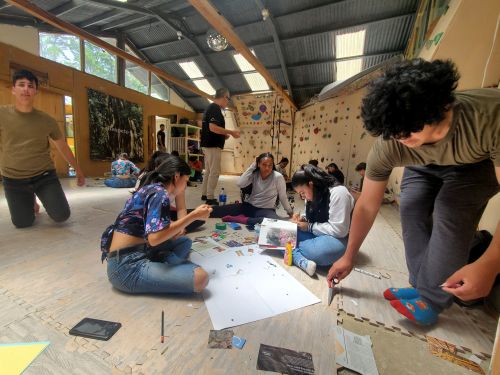
Students from Detroit and Costa Rica overcame language barriers to create artwork together expressing their shared concerns about the effects of pollution.
“We collaborated for a few years,” recalled Dowtin. “It was good. But there was always room for something more.” The “more” became apparent when Dowtin and Quick connected with Torrez, who brought expertise in community engagement and the arts.
The Green New DEAL
Together they created an arts-based ecology program that would blossom into the Green New DEAL. They decided to focus on microplastics and macroplastics as part of a capstone project for the Detroit students, Quick said. The arts brought a crucial element to their research, she said.
“It’s a great way for some students to be able to illustrate their understanding of environmental contamination through music, poetry, and manipulative artwork,” Quick said. “Some students do better if they are able to express themselves through music or the arts.”
Dowtin, Quick, and Torrez co-authored grant proposals and received funding for the Green New DEAL through MSU’s Creating Inclusive Excellence Grant (CIEG), RCAH’s Network for Global Civic Engagement, and the Michigan Chapter of the Society of American Foresters.
During the fall semester 2022, MSU students including Jasmine Brown, a Ph.D. candidate in forestry, and University Prep seniors mentored juniors as they studied urban ecology. Students formed research pods, focusing on microplastics, macroplastics, industrial pollution, and urban-agricultural pollution.
In the spring, University Prep juniors worked with Detroit artists who helped them demonstrate what they learned and share their vision for their city with their peers through poetry, spoken word, an audioscape, and visuals. The artists included visual artist Meg Heeres, poet Will ‘The Poet’ Langford, and audio experimentalist rocket(!!!)man.
Together they explored the question “What would a reforested Detroit do for our community?” Torrez said. “We [encouraged] youth to consider the reasons behind the loss of green spaces in Detroit, who has access to these areas, and how we can (re)imagine these spaces into existence.”
Costa Rica Collaboration
During the 2022-2023 academic year, MSU and University Prep students also were meeting via Zoom with high school students in Costa Rica. “We were having conversations about the impact of microplastics in water in Detroit,” Torrez said. “We were coordinating with a high school group in Costa Rica about similar questions around land.”
RCAH has a longstanding relationship with Costa Rica through a study-abroad program coordinated by founding director Vincent Delgado. Dowtin, Torrez, and Quick traveled to Costa Rica with a small group of students from University Prep and MSU in summer 2023. Together they participated in arts-based workshops focusing on ecological themes.
They quickly learned that art is a universal language; by Day 2 the students were joking and laughing together via Google Translate. “Our students did not speak the same language,” said Dowtin. “But we’re out here creating together, advocating for our land together.”
In fall 2023, the U.S. and Costa Rican students shared their work in an art exhibition at RCAH’s LookOut! Gallery.
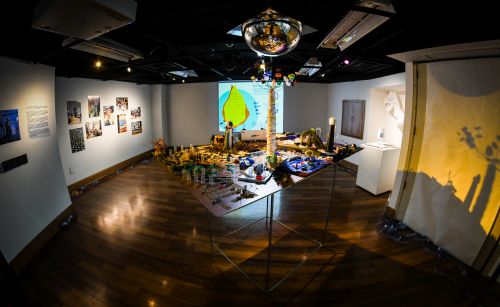
MSU and University Prep students exhibited their work as part of the Green New DEAL (Detroit Ecological Arts Leaders) at RCAH’s LookOut! Gallery.
Reimagining Detroit
Torrez and Dowtin continued to collaborate with Quick and her University Prep students during the 2023-2024 school year.
That fall, students in Torrez’s class and University Prep students engaged in a joint reading of the book Racist Roots: How Racism Has Affected Trees and People in Our Cities – and What We Can Do About It by Christine Carmichael, who holds a doctorate in forestry from MSU.
Reading the book sparked conversations about green spaces in Detroit, with students encouraged to reimagine parts of their neighborhoods. Visual artist Meg Heeres helped students create a series of maps based on their vision for the future. That spring, students planted trees on school grounds, as well.
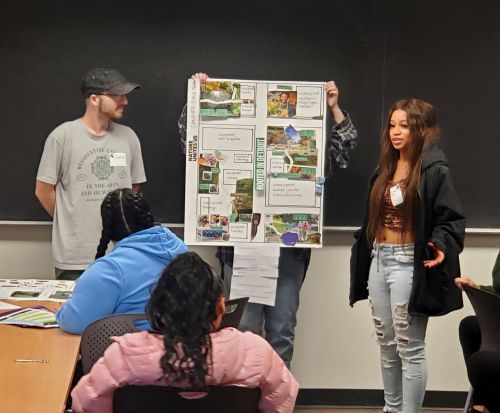
MSU and University Prep students display their renderings of a reimagined Detroit neighborhood transformed by community-based greening initiatives.
Quick’s students used recyclable products to create model landscapes representing their community. “They were able to use what they had been learning to create something they would imagine as a beautiful city,” Dowtin said. “To see them feel empowered to do that, to me it gave me a level of hope.”
Students also created zines (unconventional self-published magazines), including poetry, photography, and art to express their views about urban planning and how pollution affects them. University Prep and MSU students worked in small groups to create their own zines, in which they expressed not only their views about urban planning, but their reimagined visions of how different neighborhoods could be transformed by increased greenery and inclusive engagement of all community members.
As a chemistry and biology teacher, Quick found it rewarding to see students learn about these concepts and express them through art, music, and poetry. “The students could really shine in those areas.”

University Prep teacher Heidi Quick (left) talks with a student building a model that would add more trees to Detroit’s urban landscape.
MSU students in the RCAH course, titled “Methods in Community Engagement: Youth Participatory Action Research with DEAL,” also benefited from the project, Torrez and Dowtin said.
Throughout the school year, MSU students regularly visited their counterparts in Detroit, and the Detroit students visited MSU. “It took our concept of community engagement from textbook and classroom to the streets of Detroit,” Dowtin said. “It was a very mutually beneficial learning experience for students from both campuses.”
The experience also enabled humanities students to learn about fundamentals of urban forestry, and about the connection between nature and community well-being in cities, she added.
Torrez, Dowtin, and Quick have used this past academic year to reflect on the project and explore ways to share it with others. They are in the process of preparing publications and have presented them at national and regional conferences. “We wanted to make sure that we can get this work out to the world,” Torrez said.
They’d also like to obtain funding to continue their work with a new generation of students. Quick envisions collaborating with the Michigan State Parks with a possible focus on the effects of pollution on Detroit’s Belle Isle. “I would love to get more kids involved,” she said.
Reference
Carmichael, C. (2024). Racist roots: How racism has affected trees and people in our cities – and what we can do about it.
- Written by Patricia Mish, University Outreach and Engagement
- Photographs courtesy of Asia Dowtin and Estrella Torrez