Promoting Emergent Literacy
- Nell K. Duke
- Department of Teacher Education and Department of Counseling, Educational Psychology, and Special Education
- Colleges of Education
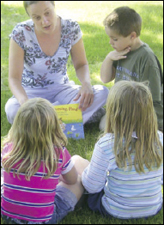
Promoting emergent literacy helps give children the foundation they need for success in school.
It's never too early to read to a child. Now Michigan policy makers and MSU literacy experts have teamed up to promote reading to our youngest citizens in child care settings.
The Promoting Emergent Literacy in Licensed Care Project, led by Nell Duke of MSU's Literacy Achievement Research Center, produced a DVD and booklet designed to help educate child care staff about children's learning experiences from birth through five years of age. The materials were presented to the Michigan Department of Human Services for distribution to 20,000 licensed child care providers across Michigan.
The effort is a result of groundbreaking State of Michigan policy that requires all licensed child care centers to include at least 30 minutes a day of developmentally appropriate literacy activities. Typically, child care requirements have focused on issues of safety and staffing rather than curriculum.
"One of the challenges," Duke said, "was to help child care providers understand ways to foster emergent literacy development—for 30 minutes and beyond. How do you introduce books to infants and toddlers? How do you make print a part of everything from mealtimes to pretend play? Our first steps were to identify age-appropriate literacy activities and ways to include them in daily activity. We also showed the video to teachers and early childhood experts during various stages of its development, and used their feedback to make adjustments."
"Children learn more from birth to age three than any other time in life," said Michigan Department of Human Services director Marianne Udow. "Our challenge is to ensure that every child born in Michigan reaches kindergarten with the intellectual and emotional foundation necessary to succeed in school."
Funding sources included MSU Families and Communities Together (FACT) Coalition, MSU Literacy Achievement Research Center, MSU School of Social Work, W.K. Kellogg Foundation, and the Child Day Care Licensing Division of the Michigan Department of Human Services.
- Written by Carla J. Hills, University Outreach and Engagement