Healthy Soil, Stronger Farms: MSU Researchers Partner With Michigan Farmers
- Christine Sprunger, Ph.D.
- Associate Professor, Department of Plant, Soil, and Microbial Sciences
- College of Agriculture and Natural Resources
Project Overview
- This study examines the impact of measures to improve soil health on greenhouse gas emissions, climate change, crop yields, and the long-term sustainability of farms.
Products/Outcomes
- A database that shows the connection between agricultural management practices and biophysical measurements of soil health.
- Recommendations for farming practices that can rejuvenate soils, mitigate climate change, and sustain and improve crop yields.
Funders
- Agricultural Resiliency Program funded via a partnership between Michigan Department of Agriculture and Rural Development and Michigan State University
Partners
- Michigan farmers from across the state
- MSU Extension
Form(s) of Engagement
- Community-Engaged Research
- Community-Engaged Service

Christine Sprunger
One thing Brandon Blain loves about farming is the view from his tractor as he glances over his shoulder during the spring planting season.
“I get that immediate gratification because I just turned that weedy field into a smooth field of dirt,” said Blain, who grows corn, wheat, and soybeans on his 2,000-acre family farm in Williamston, Michigan.
But come harvest time, what excites him most about farming is analyzing management and yield data for each field to plan for the following year. “I strategize day and night,” Blain said. He particularly values detailed soil health reports he receives through his partnership with Dr. Christine Sprunger, an associate professor of soil health with the Department of Plant, Soil, and Microbial Sciences, and her research team.
Historically, farmers have had to make decisions to improve soil health “on blind faith,” Blain said. The reports provide him with measurable data showing the impact of his decisions on improving soil quality and, consequently, yields, he said.
Blain is one of 90-plus farmers across Michigan participating in Sprunger’s study examining the impact of measures to improve soil health on greenhouse gas emissions, climate change, crop yields, and the long-term sustainability of farms.
Funded with a $1.5 million Agricultural Resiliency Program grant from the Michigan Department of Agriculture and Rural Development and Michigan State University, the study is titled “Ensuring the Success of Michigan Farms in the Face of Climate Change: Assessing Linkages Between Soil Health, Greenhouse Gas Emissions, and Cropping System Resiliency on Michigan Farms.”
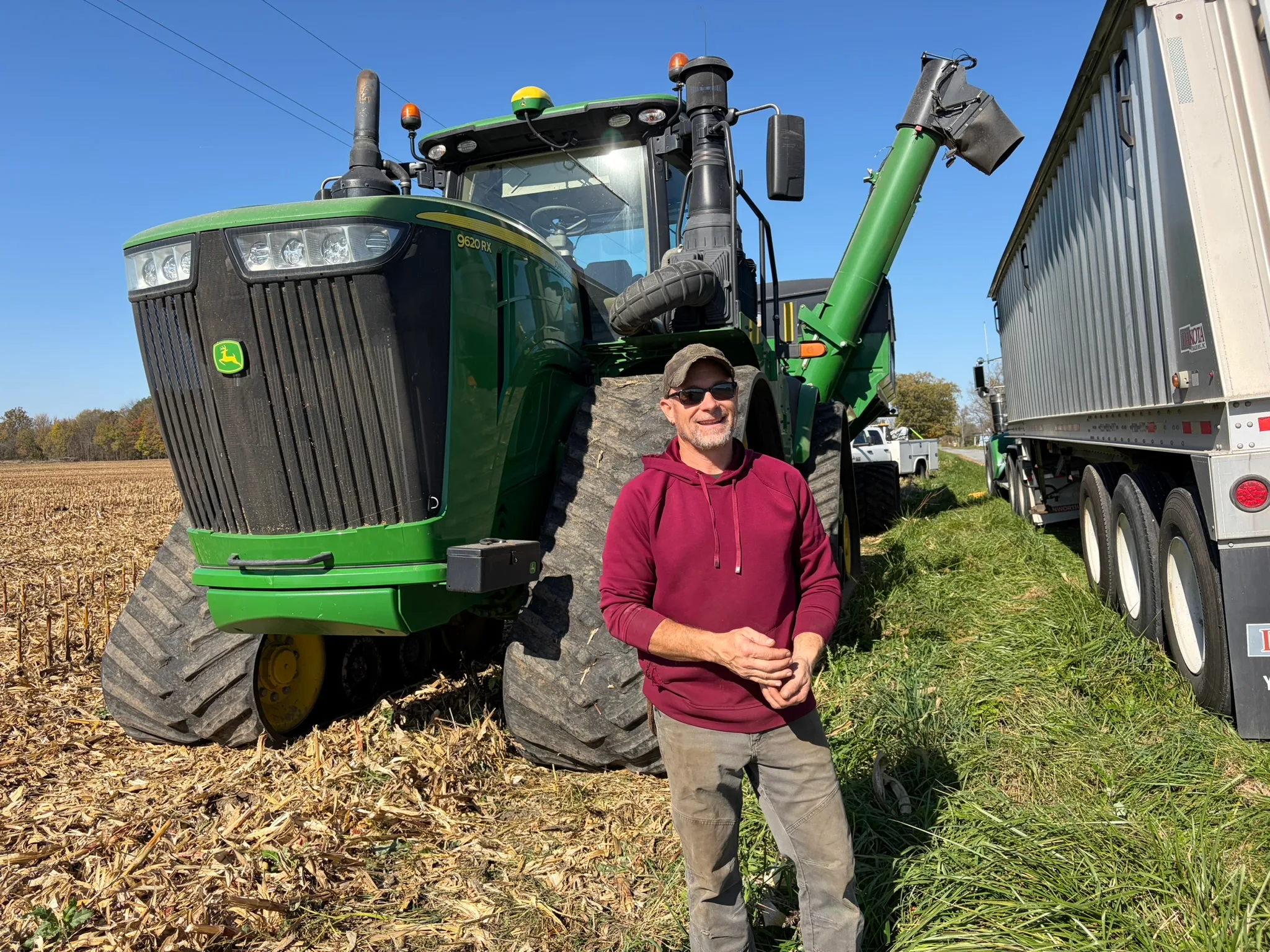
Brandon Blain of Gustafson Farms takes a break during the corn harvest. Participating in the MSU study has helped take the guesswork out of strategies to improve soil health, he says.
The project team is led by Sprunger and includes 12 co-principal investigators, half of whom are MSU faculty and half MSU Extension educators. The Extension team tapped its network of farmers to participate.
Why Soil Health Matters
Sprunger, who holds a Ph.D. in crop and soil sciences and ecology, evolutionary biology, and behavior from MSU, is based at the Kellogg Biological Station’s (KBS) Long-Term Agroecosystem Research (LTAR) site. Her research focuses on identifying best management practices for improving soil health, which she said can lead to enhanced crop productivity for farmers while at the same time mitigating climate change.
“We really feel that improving soil health, which we see as the capacity for soil to support plants, animals, and humans, is really the answer to addressing both climate change mitigation and climate change adaptation,” Sprunger said.
That formula results in greater resiliency, which “not only helps farmers meet the yields they want to achieve, meet their economic goals, but it also helps them with long-term sustainability of their farms,” she said.
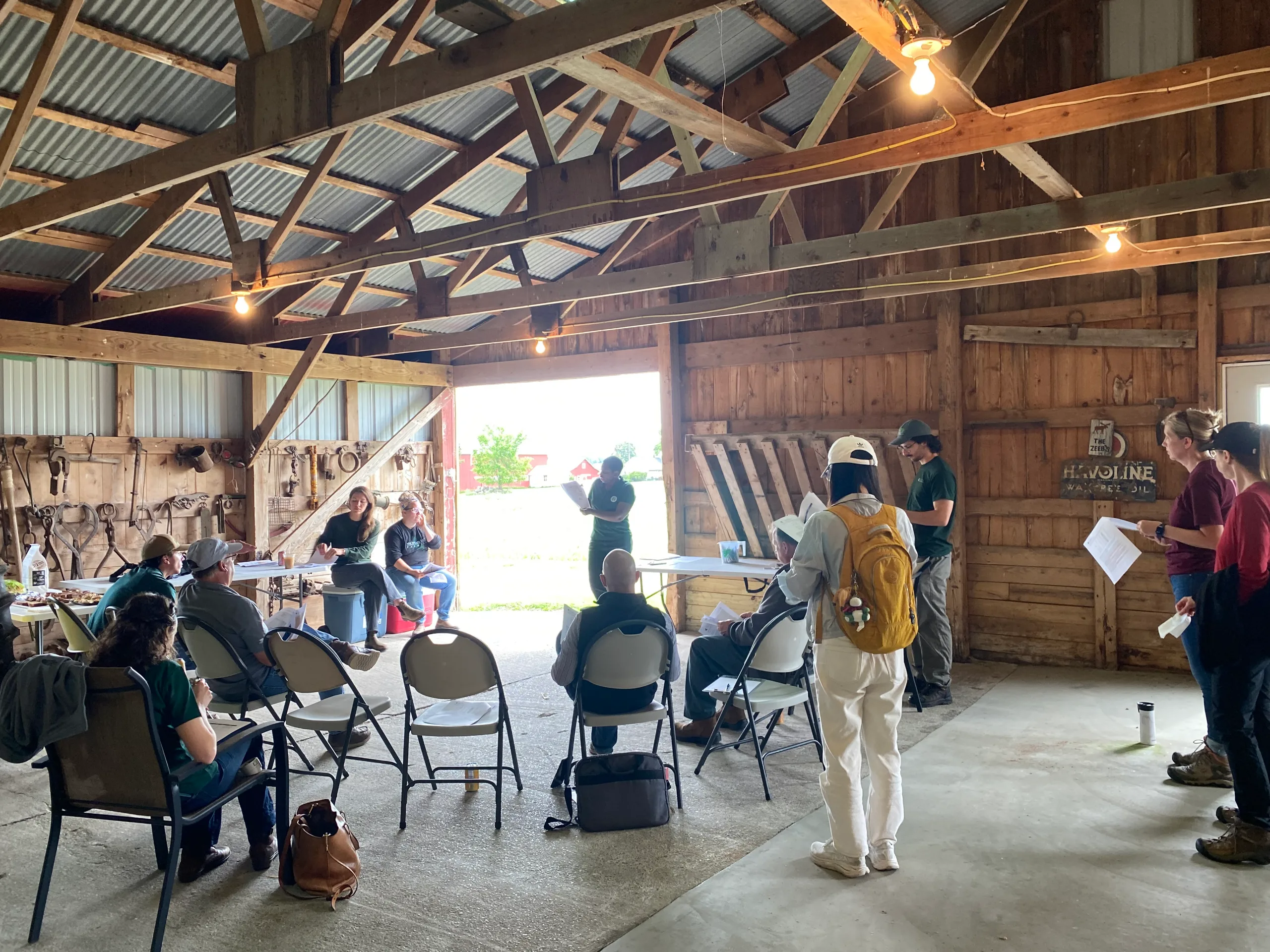
Christine Sprunger speaks to farmers, Extension educators, and researchers at Zeeb Farm, near Ann Arbor, hosted by Andrea Zeeb Polverento.
From Test Plots to Working Farms
Sprunger leads soil-health efforts at the LTAR, a test farm established by the U.S. Department of Agriculture to develop strategies for sustainable agricultural production. Located on the KBS grounds in Hickory Corners, Michigan, the site consists of 32 small plots with crops including corn, soybeans, wheat, and canola.
The farmland is divided between “business as usual” and “aspirational” plots. The business-as-usual plots are farmed using conventional methods, which include using fertilizer, tilling the soil, and leaving the fields bare between growing seasons.
The aspirational plots incorporate practices designed to improve soil health and nutrient retention. After harvest, cover crops such as red clover are planted and the plots are “no-till.” Using organic matter rather than fertilizer and decreasing disturbances of the soil result in increased carbon, Sprunger said.
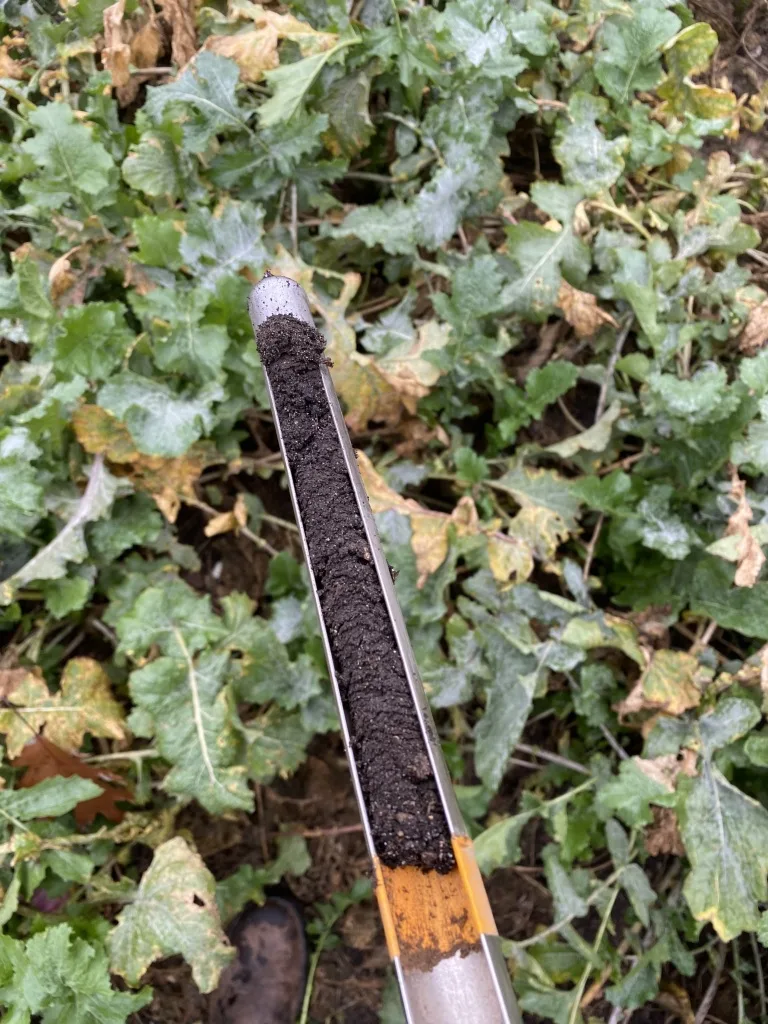
Climate resiliency technicians collect samples at participating farms to assess soil health.
Known as the building block of life, carbon is a chemical powerhouse. “Increasing carbon leads to higher crop production,” Sprunger said. “From an environmental perspective, increasing carbon is critically important for climate change mitigation.”
To imagine what happens when soil is deprived of carbon, recall the Dust Bowl of the 1930s. Intensive plowing removed protective vegetation and depleted soil carbon, weakening soil structure and reducing its ability to retain water. When drought struck, the exposed soil became vulnerable to wind erosion, producing severe dust storms that carried away carbon-rich topsoil and further diminished soil fertility.
Demonstrating the benefits of regenerative agriculture in a controlled environment like KBS is one thing. “We’re just working with one climate, one soil type, one way of managing,” Sprunger explained. It gets much harder to demonstrate that on working farms,” Sprunger said. “That is why involving farmers from across Michigan is critical. We want to really understand how we can help farmers achieve improved soil health on working farms.”
A Partnership with Michigan Farmers
Farmers who agreed to participate for 1 year receive a free soil test. The research team also recruited 25 farmers willing to participate for 3 years. Of those, one group uses conventional farming methods while another uses at least one regenerative practice, such as cover crops.
In addition to more detailed soil testing, the 25 farmers agreed to have greenhouse gas chambers placed in select fields to measure emissions. MSU technicians visit their farms weekly or biweekly to take samples. They communicate with the farmers regularly and remove the chambers prior to planting and fertilization. Participating farmers also agree to be interviewed by social scientists and agronomists on the team.
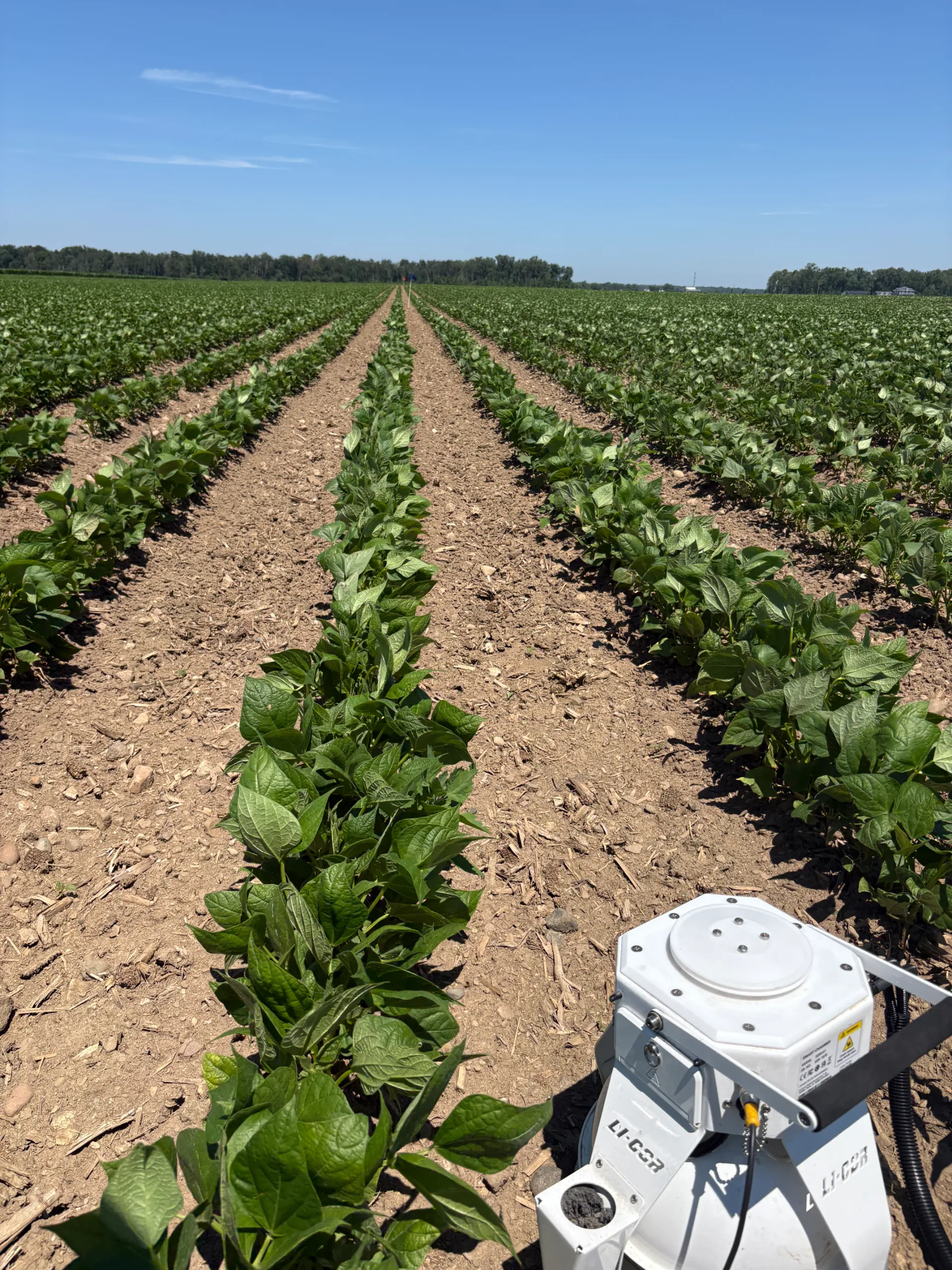
Greenhouse gas chambers are placed in fields to measure greenhouse gas emissions, which can help farmers pinpoint nitrogen losses.
While each receives an honorarium, farmers overwhelmingly tell Sprunger what they most value are the soil health reports. They also appreciate one-on-one consultations with MSU Extension educators and field days where they meet with other farmers from across the state.
Blain, of Gustafson Farms, describes his operation as “business-as-usual” farming, noting that his acreage is neither organic nor no-till. “That’s the way most of the acres in Michigan are farmed,” he said.
A few years ago, working with an MSU Extension soil health educator, he noticed soil compaction issues. “My next question was, ‘How do I fix it?’” he recalled. “Because I’m chasing yields. At this point in my career, I need the farm to be profitable.”
Based on MSU Extension’s recommendations, Blain began using different tillage methods and cover crops to improve water infiltration and nutrient retention. However, while every farmer wants to improve soil health, until recently there was no standard way to measure the impact of changes, he said.
Enter the Sprunger Lab, which, through the study, is providing Blain quantifiable data on soil health. Blain is entering his third growing season as part of the study. He has two fields enrolled, where technicians monitor greenhouse gases and do regular soil testing. “As I’m farming, they are gathering data on what is happening in the soil,” he said, noting that the reports show improved organic matter, microbial life, and reduced compaction. “All the data coming back after 2 or 3 years supports the changes I decided to make,” he said.
In addition to collecting soil samples and measuring greenhouse gas emissions, the research team interviews farmers like Blain and conducts an annual management survey. “We have very detailed information on what farmers are doing on each field they’ve enrolled in the project,” Sprunger said. “What’s really novel about this study is that we’re working to connect that management history with these biophysical measurements.”
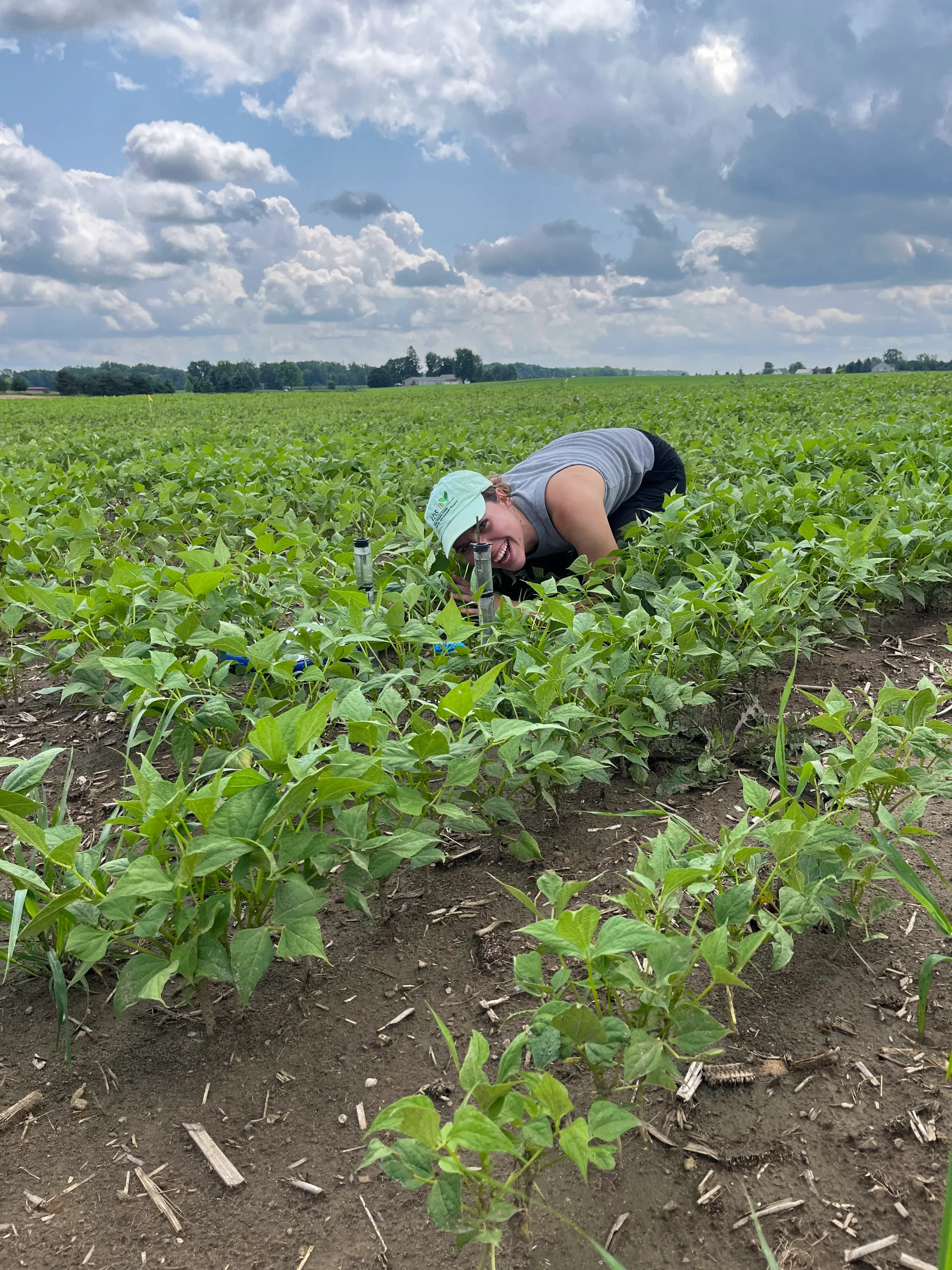
Meredith Mann measures water infiltration at a participating farm.
Additionally, the team incorporates feedback and questions from farmers into the research year to year. “We value the co-production of knowledge with farmers,” Sprunger said.
Promising Outcomes
Farmers and researchers alike already are reaping benefits from the study. Having sampled thousands of farms across the Midwest, “We can tell farmers, for your soil type, you’re above average or below average,” Sprunger said, adding that they can then recommend specific practices to improve soil health.
As with soil health, much of the research on greenhouse gas emissions has been done at university research stations. Measuring emissions on working farms can help researchers understand how management practices and cropping systems can reduce those emissions, improve water quality, and mitigate climate change. For farmers, the data can reduce costs by identifying where to apply fertilizer with more precision, for example.
Until joining the study, Kevin Messing said he had not realized the extent to which fertilizer applications can increase greenhouse gas emissions. Messing, an agronomist with Michigan Sugar Company and an MSU graduate, farms 120 to 140 acres in Huron County with his wife as a hobby. They grow alfalfa, corn, wheat, and beans.
With his land surrounded by water on three sides, he has begun using cover crops to reduce fertilizer and minimize runoff. More recently, he’s begun transitioning to organic management. He hopes Sprunger’s study can be extended so that he can see how these changes improve soil health and yields. “We’re just at the tip of the iceberg,” he said.
The ramifications of the research extend well beyond the farmers and their fields, something Sprunger realized as an undergraduate at the University of Washington when she randomly chose a soil science course. “It just hit me that soil science can both address food security needs while also addressing the climate crisis,” she recalled. “For me that’s always been the driver: Making sure that society has the food that it needs. But can we do that in a way that is sustainable?”
Sprunger and her team of researchers and farmers will continue to seek those answers for at least one more growing season. Sprunger recently received funding from MDARD to extend this work and also explore soil health in specialty crops across the state of Michigan.
- Written by Patricia Mish, University Outreach and Engagement
- Photos courtesy of Christine Sprunger unless otherwise indicated