A Game Plan for Connectivity: MSU, Community Partners Address Rural Digital Gaps
- Jean Hardy, Ph.D.
- Assistant Professor, Department of Media and Information
- College of Communication Arts and Sciences
- Cory Heald, M.A.
- Professor of Practice, Department of Media and Information
- College of Communication Arts and Sciences
Project Overview
- A board game model is used with rural communities to facilitate conversations about how to allocate resources to increase broadband access and digital equity.
Products/Outcomes
- Connected Community, a resource-allocation board game that helps players arrive at the best strategies for expanding digital opportunities in their communities.
Partners
Form(s) of Engagement
- Community-Engaged Creative Activity
- Community-Engaged Service

MSU’s Cory Heald and Jean Hardy worked with Merit Network to create the Connected Community board game.
Jean Hardy knows firsthand the challenges rural communities face when it comes to broadband infrastructure and digital equity.
Hardy, an assistant professor with MSU’s College of Communication Arts and Sciences, lives on a 42-acre farm 30 miles from East Lansing with no wired Internet access. Facing the prospect of a $127,000 price tag to connect via fiber, he opted for Starlink, a satellite Internet provider.
Residents in rural areas across Michigan face a plethora of digital challenges as varied as the state’s terrain. They may have access to broadband, but at a higher cost than in urban areas. Even where broadband is available, other challenges arise, whether keeping young people safe online or helping seniors navigate health-care portals. Geographic inequality can exacerbate these digital inequities, according to Hardy’s research on the “rural information penalty.”
Rather than launch a strategic planning session or organize a workshop or seminar, Hardy chose an unconventional approach to help local leaders bridge the digital divide: a board game called Connected Community.
“Everybody loves to play a game,” he said. “I see games as a really powerful tool because they’re so welcoming to people, and they can be leveraged in these unique ways to collect interesting data.”

Jean Hardy
Hardy’s work focuses on researching broadband infrastructure and digital equity, so he tapped the expertise of MSU colleague Cory Heald, who teaches game design. They created a role-playing game that challenges players to think creatively about how best to allocate resources to achieve goals ranging from connecting the local library to broadband Internet to implementing a digital literacy campaign.
“We literally took the work of being part of a community broadband task force and transformed it into gameplay,” Hardy said. “You win by doing the things that are best serving your community.”
A Partnership to Bridge the Digital Divide

Cory Heald
The project is a collaboration with Merit Network, a nonprofit that works to expand Internet access for education, government, health care, libraries, and nonprofit organizations in Michigan and beyond.
Merit approached Hardy in 2025 after receiving an $831,865 grant from the U.S. Department of Agriculture (USDA) under the Rural Utilities Service’s Broadband Technical Assistance program. The program focuses on providing technical assistance to rural communities identified as high need to develop digital skills, enhance online safety, and strengthen digital readiness for municipalities and businesses.
As part of the grant, Merit deployed the Digital Opportunities Compass, a framework for broadband and digital equity planning to help rural communities expand affordability and access, said Megan Knittel, Merit’s digital opportunity project manager. The framework was co-authored by Johannes M. Bauer, director of the MSU Quello Center. “We go into communities and recruit a citizen task force to serve as a focus group and inform our efforts,” Knittel said.

Megan Knittel
Hearing from residents and noting that few had experience with strategic planning led Knittel to contact Hardy, whom she had met while completing her doctorate at MSU, and Heald, a professor of practice who specializes in game design.
The idea was to take a “serious games” (a genre that uses games to solve problems) approach to: “How can we help people build that strategic planning perspective and evaluate their own community’s capacity to engage with some of these issues?” Knittel said. “There’s a lot of evidence to suggest that playing a game can be really valuable for building some of these skills.”
Using Games to Navigate Broadband Challenges
Knittel was aware of Hardy’s work on an earlier project called The Game of Rural Life, based on his extensive research on broadband equity in the Eastern Upper Peninsula. Prior to developing the game, he and his graduate students designed workshops “to get people to engage in conversations about what Internet infrastructure might look like in rural communities,” Hardy said. But few residents participated.
“We opted to create the first board game in response to this,” Hardy said. “We were trying to engage people in a more creative and playful way of thinking about problems.” Funding constraints prevented Hardy from deploying the game in the Eastern Peninsula, so he tested it with MSU students who grew up in rural areas. “The rural students found the game to be a productive way to reflect on their own experiences of digital disconnectedness and to learn about other people’s experiences,” he said.
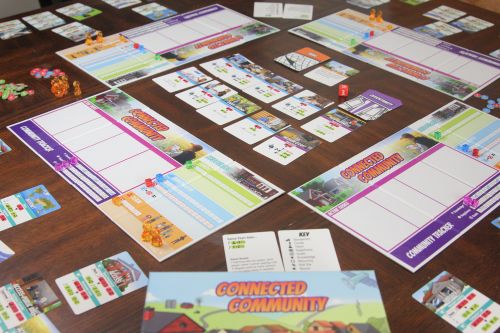
The Connected Community board game offers leaders a playful way to consider how best to allocate resources to improve digital access and equity.
When Merit approached him about the USDA grant, Hardy reached out to Heald to create a more polished board game that would focus specifically on communities and broadband task forces.
Heald suggested a role-playing game that would encourage players to invest limited resources in broadband access and equity, navigating challenges along the way. Players collect resources including staff/volunteers, funding, and bandwidth (capacity), then allocate them to various community broadband and digital equity programs.
The game also encourages conversation. “After your turn, you talk through what you did, why you did it, and kind of explain that to everybody so they can see what those challenges were and why you made those decisions,” Heald said.
Merit Network staff participated in pilot testing and suggested game scenarios based on community surveys and interviews. “We used what we heard and learned directly from residents’ experiences to inform the text on the cards and the scenarios in the game,” Knittel said. Examples include meeting with an Internet service provider and the impact of weather-related service disruptions.
Engaging Communities Through Play
The game immerses participants in real-world decision-making, Knittel said. “Connected Community puts [players] in the position of a member of a local broadband task force where you’re actually making decisions about how to invest resources, financial and otherwise, to improve your community’s broadband infrastructure or develop digital literacy programs,” she said.
Unlike meetings or seminars, participating in a game offers an opportunity for participants to grapple with complex issues yet have fun doing it, Heald and Hardy said. The “decision tree” in the game gives players an opportunity to make choices based on their specific situation.
“If you go to a workshop, you might hear what’s going on. You might write down some notes. But you’re not actively thinking about how this is going to achieve something down the road,” Heald said.
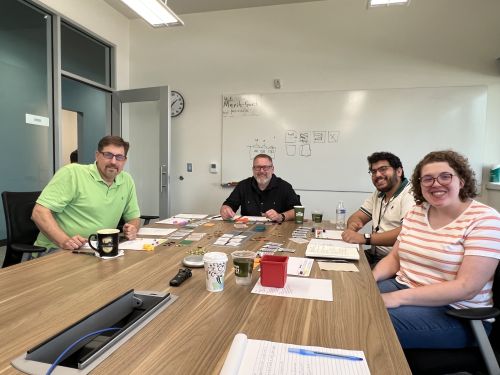
MSU’s Cory Heald (center) facilitates a Connected Community game‑testing session with Merit Network staff to gather feedback. Megan Knittel, Merit’s digital opportunity project manager, is pictured at right.
“If you can get engagement where people are excited to learn about something and interact with the information, then you’ve got a captive audience,” he continued. “They’re not daydreaming about what they are going to do when they get out of this seminar.”
The goal of the game is not to increase broadband access or solve digital equity issues for communities, Hardy said. “What we are really interested in is developing the capacity of communities to deal with these problems themselves,” he explained. “We know that sustainable solutions best come from communities themselves.”
It’s about capacity-building, he said. “And helping communities determine: What are the most pressing problems for us to address right now when it comes to broadband access and digital equity? And helping them prioritize those things.”
As part of his research, Hardy also plans to measure the impact of the game by evaluating its impact on communities’ efficacy in broadband planning.
Preparing for Community Rollout
For now, Merit is holding off on deploying the game with broadband task forces that are part of the grant while collecting data to determine community needs and existing digital resources.
In the meantime, Knittel would like to deploy the game with Merit members including digital equity committees, local governments, and organizations like schools and libraries. “It’s been exciting to develop something new,” she said. “I’m excited to see it continue to have value and hopefully expand to other communities.”
Hardy and Knittel also have met with organizers of the Tribal Broadband Bootcamp, a national organization that brings together Tribal leaders to explore how to tackle broadband equity issues in their communities.
“They were interested in potentially bringing us out to one of their big events this summer,” said Hardy, which would provide an opportunity to introduce the game to several communities. “We thought that would be really awesome and a unique population to deploy it with.”
“I think it’s going to be a useful tool to deploy with any community organizations that are place-based and are interested in doing digital equity work,” he said. “Whatever community is willing to put four people in a room and play a game with me, I’ll sign them up.”
- Written by Patricia Mish, University Outreach and Engagement
- Photographs courtesy of Jean Hardy and Cory Heald