Awards Ceremonies Honor Exemplary Community Partnerships
Their work has touched communities from Detroit, Lansing, and Northern Michigan to the Himalayas and Brazilian Amazon.
This spring, MSU researchers and their community partners, along with graduate and undergraduate students, were celebrated for their accomplishments in community-engaged scholarship and service.
Elena Ruíz, College of Arts and Letters, and community partners Sara’s House and Women Healing Eternally and Transforming (WHEAT) of Detroit, received the Community Engagement Scholarship Award (CESA) at the All-University Awards Ceremony on April 7.
One of 10 all-university awards conferred, the CESA recognizes exemplary, impactful engaged scholarship in collaboration with a community partner. Ruíz and her community partners were honored for their 4-year partnership to address the overwhelming public health crisis of gender-based violence in Detroit.
Ruíz was also recognized at the annual Outreach and Engagement Awards Ceremony on March 12. The ceremony featured special recognitions, including the Lifetime Achievement Award and Institutional Champion Award, in addition to recognitions for faculty, staff, and students for their collaborative work with communities involving research, teaching, and service.
Recipients of the UOE’s 2026 awards include:
Michigan State University Community Engagement Scholarship Lifetime Achievement Award
Recognition of outstanding and sustained accomplishment in community-engaged scholarship through research, creative activity, teaching, and/or service. Given the special nature of this distinction, it is not intended to be an annual award but conferred only on those occasions in which the extraordinary accomplishments of an engaged scholar warrant it.

From left: Gregg Hill, jazz composer; Ken Jones, Summer Solstice Jazz Festival; Rodney T. Whitaker, College of Music; James Forger, dean, College of Music; and Kwesi Brookins, vice provost for University Outreach and Engagement.
Rodney T. Whitaker, College of Music
For Rodney T. Whitaker, a world-renowned jazz artist, educator, and scholar, mentorship is at the heart of his life’s work. “I had this vision about 20 years ago that I would raise 1,000 mentors in my lifetime,” he has said. “And from that 1,000 they would raise their 1,000 and so on. Through jazz [we] can change the world.” As an MSU faculty member for 30-plus years, Whitaker has brought that philosophy to MSU’s College of Music and beyond. His emphasis on innovation, collaboration, and mentorship has enabled graduates to sustain successful music careers while enriching the music community worldwide.
A Mack Avenue recording artist from Detroit, Whitaker is one of the leading bass performers and teachers of the jazz double bass in the nation. He has toured the world, performing with symphony orchestras and artists such as Diana Krall; Crosby, Stills and Nash; and Dizzy Gillespie.
At MSU, Whitaker is director of jazz studies and a University Distinguished Professor of Jazz Bass. He has presented master classes, clinics, and workshops across Michigan, the United States, and Asia. He has served as a lead educator with Jazz at Lincoln Center and the Essentially Ellington program for high school jazz bands and music educators.
Whitaker has guided the MSU Community Music School-Detroit jazz education and its collaborations with the Detroit Symphony Orchestra youth ensembles and Detroit public schools. He has also served as artistic director of the East Lansing Summer Solstice Jazz Festival. In 2024, he was elected to the prestigious American Academy of Arts and Sciences.
Institutional Champion Award for Community Engagement Scholarship
Recognition of an individual, team, or initiative for leadership in institutionalizing community-engaged scholarship and university outreach at MSU.

From left: Teresa Mastin, vice provost and associate vice president for Faculty and Academic Staff Affairs; Andrea L. Wendling, College of Human Medicine; and Kwesi Brookins.
Andrea L. Wendling, College of Human Medicine
Andrea Wendling, a physician and a professor with the College of Human Medicine’s Department of Family Medicine, is a nationally recognized leader in rural medicine. In 2012, she created the Leadership in Rural Medicine (LRM) Certificate Program, a partnership between MSU and communities across Michigan to help address the shortage of physicians in rural areas. The program recruits students interested in rural medicine and provides them with comprehensive, community-engaged training in rural areas throughout the state. Its goal is for students to develop the confidence, comfort, and professional and personal skills necessary to care for patients in rural and remote areas.
Wendling also developed the Rural Community Health Program (RCHP), which links MSU’s Midland and Traverse City campuses to rural underserved regions of Michigan. RCHP students split their clinical training between their main campus and a single rural educational community.
To encourage students from rural areas to pursue medicine, she developed MSU’s Rural Premedical Internship Program. The summer program offers shadowing experiences, rural community service opportunities, and application and interview skill-building. She has also been instrumental in developing the MSU-affiliated MIDOCS residency programs in underserved rural communities and the Indigenous Pathway Program with the Little Traverse Bay Bands of Odawa Indians.
Through these initiatives, Wendling has elevated the national reputation of MSU and built lasting community partnerships throughout the state. She continues to practice family medicine in Northern Michigan.
Distinguished Partnership Award for International Community-Engaged Scholarship
Recognition of university-community partnerships that engage in research, creative activity, teaching, and/or service outside the United States.

Marohang Limbu
Unveiling Ancient Yakthung Rhetorical Traditions: Matrilineal Civilizations and Mundhum Practices of the Himalayas
Marohang Limbu, College of Arts and Letters
Himalayan Yakthung Cultural Studies
Ya-Phedangmas
Yakthung Cultural Leaders
Marohang Limbu’s community-engaged scholarship focuses on revitalizing and sustaining the knowledge systems, oral traditions, and cultural practices of Himalayan Indigenous communities, particularly in Nepal, India, and Bhutan. Since 2014, Limbu, a Himalayan Indigenous scholar, has worked alongside Ya-Phedangmas (Mundhum ritual performers or shamans), Tumyahangs (learned men), Suhangmas (learned women), elders, historians, scholars, and community institutions.
Grounded in a decolonial framework, this university-community partnership embeds scholarship in the co-research and co-documentation of Mundhum traditions, including ritual, ecological, and cosmological practices often marginalized in Western and mainstream discourses. This collaboration addresses urgent issues such as cultural erasure, linguistic decline, and ecological displacement.
Rather than extracting knowledge, the research centers community agency by co-creating ethnographic records, multilingual digital archives, and multimodal publications in Yakthung, Nepali, and English. These collaborative outputs not only preserve endangered traditions but also provide culturally relevant educational resources. They amplify Himalayan Indigenous voices in both community and global contexts, ensuring accessibility, visibility, and intellectual sovereignty.
This model of engaged scholarship transforms the university into a site of reciprocal learning and cultural healing. The work affirms the value of Himalayan Indigenous oral traditions while advancing MSU’s land-grant mission to democratize knowledge, foster global and inclusive excellence, and create sustainable, justice-oriented partnerships.
Distinguished Partnership Award for Community-Engaged Research
Recognition of an outstanding collaborative inquiry between university and community partners to discover new knowledge and/or insights.

From left: Kwesi Brookins; Geneva Jackson, founder and CEO of Sara’s House/Place; Elena Ruíz, College of Arts and Letters; Melvenna Fant-Jones, founder and CEO of Women Healing Eternally and Transforming (W.H.E.A.T); Kahlia Roberts, Research Institute for Structural Change; Cassandra Coats, board member of Sara’s House, Detroit; and Shashank Priya, vice president for Research and Innovation.
Building Capacity for Community-Led Survivor Services and Wraparound Care in Detroit Through Research-Practice Partnerships
Elena Ruíz, College of Arts and Letters
Sara’s House/Place in Detroit
Women Healing Eternally and Transforming (WHEAT)
Elena Ruíz founded and directs MSU’s Research Institute for Structural Change (RISC). The partnership between RISC and the community-led victim service providers Women Healing Eternally and Transforming (WHEAT) and Sara’s House seeks to address the overwhelming public health crisis of gender-based violence in Detroit.
Using collaborative, reciprocal methods, the 4-year partnership advances the availability of public health research to nonprofit service providers and develops the capacities of all three organizations to improve culturally responsive care to the Detroit survivor community. RISC’s engagement with the community began with a direct ask from Sara’s House and WHEAT. The partnership addresses emerging needs and leverages MSU’s resources as a land-grant university to access evidence-based data, technical support, and expertise.
Thus far, the partnership has raised nearly $400,000, used for survivor-serving programming managed by WHEAT and Sara’s House, as well as training public health advocates in community-based methods. The partnership has also generated leading-edge scholarship on community-led research methods, along with community-facing curricula in violence prevention and trauma-informed care.
RISC has partnered with community leaders to enhance the availability of culturally specific direct services and wraparound care while generating knowledge that can advance public health partnerships between universities and community organizers everywhere.
Distinguished Partnership Award for Community-Engaged Teaching
Recognition of a university-community collaboration that results in sharing knowledge and encouraging learning through formal or informal arrangements, whether credit-bearing, noncredit, guided by a teacher, or self-directed.
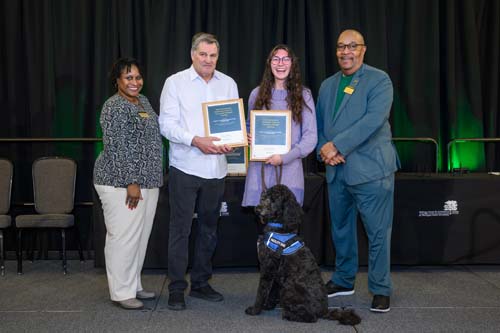
From left: Ebony Green, associate dean for Undergraduate Advising; Ross M. Chowles, College of Communication Arts and Sciences; Jenna Baker, director of prevention, Traverse City Children’s Advocacy Center; Kwesi Brookins; and Henry, facility dog.
Imagine a World Without Abuse: Advertising for Social Change
Ross M. Chowles, College of Communication Arts and Sciences
Traverse Bay Children’s Advocacy Center
It is estimated that 1 in 4 girls and 1 in 6 boys will be sexually abused before their 18th birthday. A partnership between Ross Chowles and the Traverse Bay Children’s Advocacy Center (TBCAC) has demonstrated that arts can inspire students and community members to confront the enormous costs of child sexual abuse.
This project catalyzes communities to accept that all adults are responsible for keeping all children from harm while working toward a world without abuse. TBCAC began working with Chowles in 2018, just after revelations surfaced about former MSU doctor Larry Nassar’s sexual abuse of girls over almost two decades. Chowles challenged his Advanced Creative Advertising students to produce public service announcements to prevent child sexual abuse.
Together Chowles and TBCAC developed a unique approach to this complex and taboo topic, educating MSU students, the Traverse Bay community, and professionals in the national child welfare field. Throughout the 8-year partnership, TBCAC has implemented student work in the Traverse Bay community.
In 2024, the team mounted a powerful exhibit in MSU’s Communication Arts and Sciences Building. Chowles and TBCAC have presented to state and national professionals, bringing broad attention to their arts-based approach to preventing child sexual abuse.
Distinguished Partnership Award for Community-Engaged Service
Recognition of a university-community partnership that addresses specific issues identified by individuals, organizations, agencies, industries, or communities.

From left: Kwesi Brookins; Chris Miller, founding board member, National Coalition for Community Capital; Jenan Jondy, University Outreach and Engagement; and Rebecca DeVooght, vice president for Governmental Relations.
Advancing Community-Engaged Economic Innovation: Regional Economic Innovation
Jenan Jondy, University Outreach and Engagement
Statewide Consultative Panel
The enduring partnership between MSU Regional Economic Innovation (REI) and the Consultative Panel (CP) is rooted in mutual trust and reciprocity. Since 2011, this collaboration has functioned as a learning network through which university expertise and community knowledge are continuously exchanged, jointly interpreted, and strategically applied to address Michigan’s most persistent economic development challenges.
Thirty-four CPs, representing Economic Development Districts, state agencies, local governments, nonprofits, higher education institutions, entrepreneurs, and national partners, provide deep regional insight that guides REI’s project selection, research questions, and implementation strategies in under-resourced communities. Their participation, alongside that of communities across the state, ensures that the issues studied each year emerge directly from community needs, whether related to workforce, access to capital, disinvestment, innovation ecosystems, or circular economy practices.
Student-led/faculty-guided projects, co-learning plans, and innovation fellowship projects are reviewed and co-selected by REI staff and the CP, demonstrating shared governance and decision-making. Research is not conducted on communities but with them: Communities articulate their needs, help refine methodologies, and guide interpretation of findings.
Findings are translated into publicly accessible reports, videos, podcasts, webinars, digital newsletters, and open-access publications. In this way, the REI CP partnership embodies MSU’s land-grant mission by transforming community-engaged scholarship into actionable public value, strengthening Michigan’s economic resilience, and advancing equitable development statewide.
Graduate Student Awards for Community Engagement Scholarship
Jointly sponsored by the MSU Graduate School, this award is conferred in recognition of exemplary community-engaged work by a graduate or graduate professional student. This year, four students were recognized:

From left: Pero Dagbovie, vice provost for Graduate and Postdoctoral Studies; Rafael Lembi, College of Agriculture and Natural Resources (CANR); Angelique Willis, College of Social Science; Jennifer Roedel, CANR; Chenlu Jin, College of Education; and Kwesi Brookins.
Chenlu Jin, College of Education (Community-Engaged Teaching and Learning)
Seeking to better understand Chinese American communities, Chenlu Jin partnered with Spartan Chinese School (SCS), a nonprofit heritage language school. SCS offers Chinese language classes from Pre-K to AP Chinese. Together they co-designed 1) a curriculum that centered on play and culturally relevant learning and 2) a heritage language workshop for youth volunteers. Born and raised in China, Jin’s personal encounters with linguistic bias and her research on heritage language have shaped her commitment to fostering multilingualism.
Rafael Lembi, College of Agriculture and Natural Resources (Community-Engaged Research)
Energy insecurity is a critical challenge in the Brazilian Amazon, where 1 million people live with limited/no electricity. Indigenous, riverine, and other traditional communities are disproportionately affected, as many reside in remote areas. Rafael Lembi led community-engaged research on the uptake of photovoltaic systems in Indigenous and traditional communities along the lower Tapajós River. Participatory activities helped build a consensus around energy needs, amplifying community voices about energy justice and policy change in Brazil.
Jennifer Roedel, College of Agriculture and Natural Resources (Community-Engaged Teaching and Learning)
As part of the Bee Urban Growers (BUG) Project, Jennifer Roedel collaborated with community partners to educate urban farmers and gardeners in the Detroit and Lansing areas on pollinator management. Partners included Stefanie Steele of the Xerces Society, Detroit Butterfly Nursery, Detroit Hives, Detroit artist Joseph Ferraro, nonprofits, Extension professionals, and government agencies. Together they created teaching and learning materials for growers including educational resources, presentations, hands-on demonstrations, and social media campaigns.
Angelique B. Willis, College of Social Science (Community-Engaged Service and Practice)
Angelique Willis’ work with the Atlanta Watershed Learning Network (AWLN) Alumni Group focused on a community-identified need: Many residents were uncertain about what “environmental justice” means and who to contact when harms occur. Willis, alumni, and community leaders co-developed a symposium where community leaders shared personal stories about what environmental justice looks like in their neighborhoods and how to report it. These findings now guide AWLN’s community education and engagement activities.
Graduate Student Award for Science Communication and Outreach
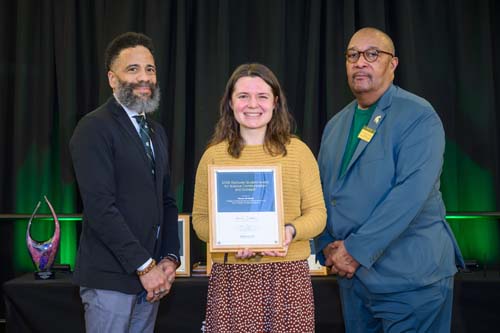
From left: Pero Dagbovie; Rachel Drobnak, CANR and College of Natural Sciences; and Kwesi Brookins.
Jointly sponsored by the MSU Graduate School, this award is conferred in recognition of the exemplary translation and communication of scholarly ideas, research findings, and advancements in all academic disciplines to the public by a graduate or graduate professional student. This year’s award recipient was:
Rachel Drobnak, College of Agriculture and Natural Resources and College of Natural Science
Rachel Drobnak’s experience helping farmers convert a portion of a sweet cherry orchard in Leelanau County into a prairie patch inspired her to build a career in outreach and communication focusing on agricultural conservation. Her efforts have included developing an Extension bulletin to calculate the cost of prairie strip conversion, conducting an on-farm research project with Michigan farmers, presenting research at agricultural events, and communicating agricultural science to the broader public.
Spartan Volunteer Service Awards

From left: James Hintz, vice president for Student Affairs; Renee Miller Zientek, executive director, Center for Community Engaged Learning (CCEL); Sumaiya Imad; Trinity Amalraj; Lauren Bradford; K.C. Keyton, assistant director, Student Volunteer Programs, CCEL; and Kwesi Brookins.
A presidential recognition, the award celebrates MSU students’ commitment to community-engaged learning and is given to students who volunteer 100 hours or more in one year. Of the 154 students who received the Spartan Volunteer Service Award, three students volunteered over 950 hours during the 2024-2025 academic year:
Trinity Amalraj, Lyman Briggs College
Lauren Bradford, College of Osteopathic Medicine
Sumaiya Imad, College of Social Science
- Written by Patricia Mish, University Outreach and Engagement
- Award ceremony photographs by Dane Robison with TimeFrame Photography