'Crossing Lines of Difference':
Through Writing, MSU Undergraduates Connect with Incarcerated Students
- Kirk Astle, Ph.D.
- Assistant Professor, Department of Writing, Rhetoric, and Cultures
- College of Arts and Letters
Project Overview
- Write On! connects MSU students and incarcerated college students for mutual writing support through workshops and one-on-one consultations.
Products/Outcomes
- Incarcerated individuals taking college courses receive writing support with topics they choose, such as grammar, punctuation, grant-writing, and bibliographies.
- Through a credit-bearing course, MSU students gain a deeper understanding of the prison system and learn how to teach others through workshops and consultations.
- The Write On! team presented at two Coalition for Community Writing conferences.
Partners
- Michigan Department of Corrections
Form(s) of Engagement
- Community-Engaged Creative Activity
- Community-Engaged Service
- Community-Engaged Teaching
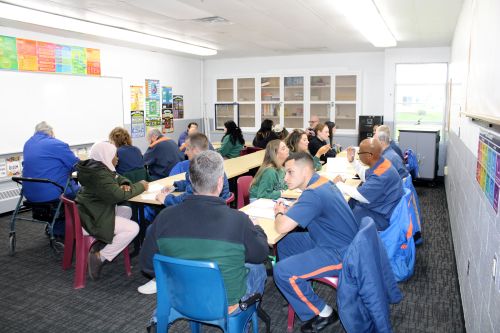
As part of the Write On! project, MSU students visit Parnall Correctional Facility once a week to collaborate with incarcerated students on projects ranging from poetry to punctuation.
Michigan State University students chat among themselves in the cramped waiting room at Parnall Correctional Facility in Jackson, unfazed by the TSA-like security process.
They place their shoes and socks in bins, walk through a metal detector enclosed in chain-link fencing, and go through a pat-down before the steel doors lock behind them. Next they walk across a prison yard ringed by razor wire to a classroom where they meet with incarcerated college students for a weekly writing workshop.
The paths that led them here stand in sharp contrast, but differences fall away as MSU students and their incarcerated counterparts put pen to paper. Whether clad in Spartan green and white or prison-issue blue and orange, here they are all writers working to improve their craft.
They meet every Wednesday as part of Write On!, a program that pairs MSU undergraduates and incarcerated college students to collaborate on projects ranging from poetry and annotated bibliographies to the complexities of the comma.
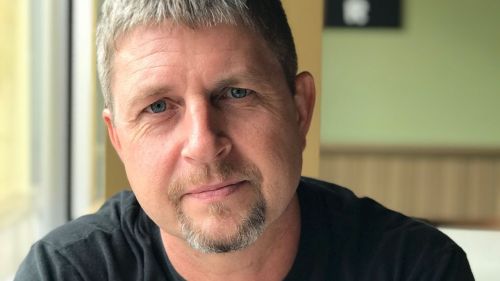
Kirk Astle
The MSU students are enrolled in Writing Inside, a course offered by Kirk Astle, an assistant professor with the College of Arts and Letters who drives students 36 miles down U.S. 127 to Parnall every week. Students present workshops on topics selected by the incarcerated writers and provide one-on-one consultations.
“Our main motivation is to humanize the experience and to change the narrative about those incarcerated,” said Astle, noting that many people base their views about prison on Orange is the New Black and Law and Order.
“Students, rather than just watching TV shows or reading the literature, get to go inside and feel the environment and work with actual incarcerated people,” he said. In doing so, they gain a deeper understanding of the realities of the prison system while at the same time becoming better writers.
How It Started
Astle describes the origins of the Write On! Project as a “happy accident,” set in motion when two former MSU graduate students—Emma Harris and Roland Dumavor—shared in class that they had previous experiences working with incarcerated writers.

Kirk Astle works on a poem with Uriah, an incarcerated student pursuing an associate’s degree in business. Uriah hopes to start his own business after his release in December 2026.
Before coming to MSU, Astle had taught writing classes inside the Jackson Prison System while serving as an adjunct professor at Jackson Community College. As he was filling out HR paperwork in an office, the dean popped in to ask if he would consider teaching inside.
“It turned out to be one of most cherished teaching experiences I ever had,” he recalled. “The guys are so authentic and real. They have a lot of life experience, and their contributions in class are why I cherish it so much.”
Astle, Harris, and Dumavor had their first meeting in February 2022. Initially they hoped to offer writing assistance to any incarcerated students interested. In meetings with Michigan Department of Corrections, they were informed the workshops would be limited to incarcerated college students, and they adapted the plan accordingly.
From the beginning, the content of the writing workshops has been driven by the needs of the incarcerated students. “We asked, ‘What would you like us to bring to you?’” recalled Astle. “It surprised me that they wanted to work on grammar.”
Brian Friedman, principal of college and vocational programs at Jackson Correctional Facility, had met Astle when he was with Jackson College. Jackson College is among several institutions that offer degree-granting programs at Parnall as part of the Second-Chance Pell Program, which provides need-based financial aid to incarcerated individuals working toward a college degree or vocational education.

Though they represent different age groups and backgrounds, MSU students and incarcerated students find common ground as they write together each week.
Friedman said he welcomed the opportunity to partner with MSU and Astle. “As somebody who is advocating for the students who are here, I want every opportunity for them to have a chance to succeed,” he said. “Everything has shown that the more education you receive, the less likelihood of incarceration over the long haul. So, we’re making a solid investment in these guys right now so that they can go out and become productive members of society.”
Connecting Students and Incarcerated Writers
Write-On! offered its first course, Special Topics: Prison Writing as Social Justice, in spring 2024. The course introduced students to writings by incarcerated people through a lens of social justice.
With the support of Danielle DeVoss, chair of the Department of Writing, Rhetoric, and Cultures (WRAC), along with Joyce Meier, professor, Astle and his team collaborated with MDOC leadership to arrive at a memorandum of understanding to bring students inside Parnall. “Trying to marry an institution like MSU to an institution like MDOC takes a lot of conversations,” he said.
They developed Special Topics: Writing Inside, a WRAC course that began with an orientation to prison writing and mass incarceration as a system. To help students prepare to work with incarcerated writers, the MSU Writing Center provided a workshop on best practices for writing consultations. Students attended an MDOC orientation that covered dress codes, policies, and safety and security practices.
“Then we hit the ground running,” said Astle, who this semester, team-taught the course with Rofiat Bello, a fourth-year WRAC doctoral student, and faculty member Nancy Grigg. The course enrolled 15 students representing a cross-section of majors including writing, supply-chain management, psychology, political science, and criminal justice.
Astle drives 10 (the maximum number allowed) students to Parnall on Wednesdays, while Grigg and Bello teach the remaining students in East Lansing. The students trade places the following week, coming together on Mondays to debrief.
Astle encourages students to note their impressions for the four required journal entries that become the basis of a longer final reflection.
Learning Goes Two Ways
While there may have been some nerves early on, the students’ comfort level has grown over the semester. When asked to work with an individual or lead an activity, they quickly volunteer.
On a recent Wednesday, students had prepared a writing workshop on poetry. Sitting side by side at long tables, an MSU student and incarcerated writer worked on a poem entitled “I Am From …,” reading their first few lines to each other. A few seats down, another student helped her counterpart unpack the intricacies of an annotated bibliography. Others needed one-on-one help with individual assignments.
Students engage in the same writing activities as the incarcerated inmates. “Whatever we ask them to do, we are also doing it,” said Bello, who helped students prepare the poetry workshop and has been involved with Write On! since the beginning. “That makes the space really collaborative.”
Natalie M., a senior double-majoring in criminal justice and broadcast journalism, reflected on what she has learned from working with incarcerated people. “They are poetic, deep, thoughtful writers,” she said. “I come back with the most fulfilling stories and experiences.”
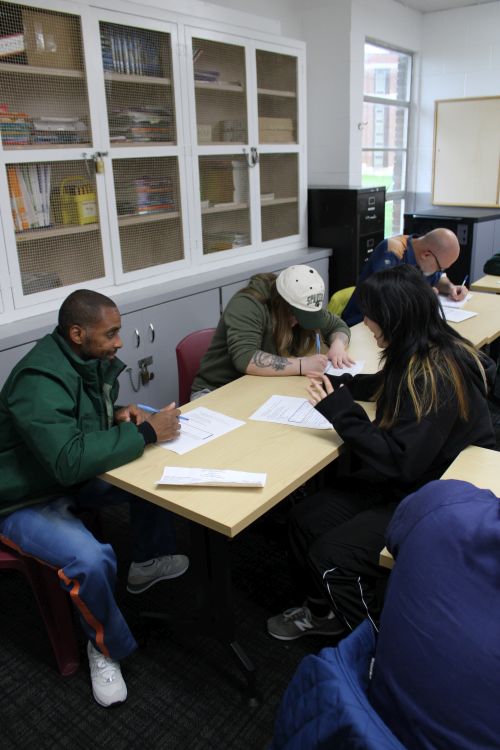
Terrell (left) participates in a poetry workshop with MSU undergraduates and other incarcerated students.
For Terrell, the quiet classroom decorated with colorful posters on the parts of speech and the basics of geometry offers a welcome respite from the noise—both literally and figuratively—of prison life. The workshops provide an opportunity to focus on his studies with like-minded individuals who also are taking college courses.
Terrell, who grew up on the west side of Detroit and quit school after eighth grade, said he is happy to give up recreational time to participate in the workshops. “Sometimes I won’t get something in class,” he said. “Here I can get one-on-one help.”
He has two more years remaining on his 20-year sentence and has been at Parnall since November 2022. After completing his GED in prison, he set his sights on an associate’s degree in business management. “I wanted to better myself and make my mother proud,” he said.
Though school proved challenging at first, he now carries a 3.8 GPA and is on track to graduate in June. He gets two tickets to the ceremony, and he lights up sharing his plans to invite his mother and a cousin. After his release, he hopes to work with his brothers in the restaurant business.
Finding Common Ground
Incarcerated writers, MSU students, and Astle stood up to read their “I am …” poems at the end of the workshop. “I am a family man, and I sleep alone at night,” he shared. Others’ poems touched on universal themes and images—light, love, trees, birdsong.
At a mention of Mammoth Cave, several MSU students and incarcerated individuals traded memories of hiking there.
“One of the phrases we use is: ‘Crossing lines of difference,’” Astle said afterward. “I see that happening all the time educationally, demographically, ideologically. Some lines are enforced by razor wire. We can still get across them.”
Next fall, Astle will divide his time between teaching Social Justice as Rhetorical Practice: Prison Writing and researching possibilities for expanding the Write On! program.
- Written by Patricia Mish, University Outreach and Engagement
- Photographs courtesy of Michigan Department of Corrections