Youth Empowerment Begins at Home: How Families Help Children Cope with Bullying
- Emilie Smith, Ph.D.
- Professor, Department of Human Development and Family Studies and Department of Psychology
- College of Social Science
Project Overview
- The Family Voices Project explored the ways parents and caregivers help elementary-age children cope with bullying and racism.
- Focus groups with children gathered information about how their families imparted a sense of positive identity and coping strategies for dealing with racism.
Products/Outcomes
- Children reported that coaching and support in advance can help them manage situations and develop coping strategies.
- Recommendation that schools and after-school programs provide resources to prepare children and their families in advance to deal with racialized bullying and implement appropriate consequences.
Partners
- Children and families who participated in focus groups
- MSU Child Development Lab
- Pam’s Academy of Champions
- Angela Stepter, community health advocate
- YMCA of Metropolitan Lansing
Form(s) of Engagement
- Community-Engaged Research
- Community-Engaged Teaching and Learning
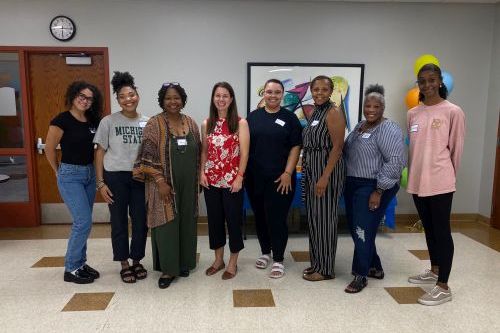
Members of the Family Voices research team gather at the Westside YMCA in Lansing. From left, Audrey Jones, then an MSU undergraduate psychology student; Simone Bibbs, Human Development and Family Studies (HDFS) doctoral student; Emilie Smith, primary investigator and HDFS professor; Kendal Holtrop, HDFS associate professor and co-I; Anneliese Samples, HDFS doctoral student; Angela Stepter, community health advocate; LaVelle Gipson-Tansil, HDFS faculty; Kennedy Perkins, then a high school intern. (Not pictured: Lekie Dwanyen, HDFS assistant professor, co-I; Deborah Johnson, HDFS professor, co-I; and Deja Young, HDFS doctoral student).
Words can hurt.
In the paper Out of the Mouths of Babes, Emilie Smith and her colleagues share firsthand accounts from elementary-age Black children about their experiences of racism.
What struck Smith, an MSU professor in the Department of Human Development and Family Studies, were the ways these young children coped with hurtful experiences like bullying, name-calling, or comments about their hair or skin. They would often draw on what their parents had taught them.
A 10-year-old girl expressed maturity beyond her years. “[She said that] some things you just have to ignore . . . you just have to know who you are,” Smith shared. “To hear her talk about framing her identity, knowing who she is, that she’s beautiful, that she’s Black, that she might have natural hair . . . but that is good no matter what anybody says. It was really impressive.”
The young girl was among 39 Black children who participated in focus groups as part of Smith’s Family Voices Project. “The paper builds on research on culturally informed practices Black caregivers use to rear their young with a healthy identity and socio-emotional skills to navigate racism,” according to Smith.
“Children reported that their parents imparted a sense of positive identity in terms of their cultural heritage, skin, and hair—areas in which they experienced frequent bullying,” wrote Smith. Black children also reported coping strategies “such as kindness, ignoring perpetrators, centering their positive identity, identity framing, and fighting back.” Parents reminded them to draw from the historical experiences of people like Ruby Bridges, who had to endure hardships with dignity, and resist in adaptive ways. Bridges was the first Black child to enter an all-white school in the South.
Youth Equity Project
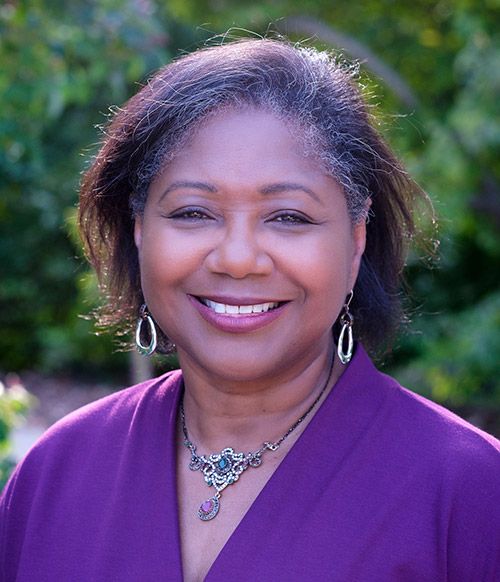
Emilie Smith
Family Voices is one of several ongoing streams of research by scholars participating in the Youth Equity Project (YEP), directed by Smith. “YEP is a collaboration of scholars who are doing interdisciplinary work to effect the positive development of youth,” she said.
The MSU College of Social Science provided seed funding for research projects focusing on reducing disparities and increasing opportunities for marginalized youth. These youth may be marginalized because of race or ethnicity, immigration status, or involvement in the child welfare or criminal justice systems.
In addition to the Department of Human Development and Family Studies, participating researchers represent the School of Social Work and the Department of Criminal Justice. YEP also includes researchers from the Residential College in the Arts and Humanities and the College of Education.
While the projects differ, the overarching goals of Smith and her colleagues’ work are to promote positive youth and family development, reduce vulnerability to substance abuse, and decrease community-level violence.
Involving multiple disciplines is vital, Smith said. “So often we silo problems. We put them into different baskets as if human beings can be compartmentalized into different areas. Doing this across disciplines allows us to take a more holistic view and we get to inform each other around different ways of thinking about the problems. And it allows us to have a more holistic perspective on youth and their families and their communities.”
Community Voices
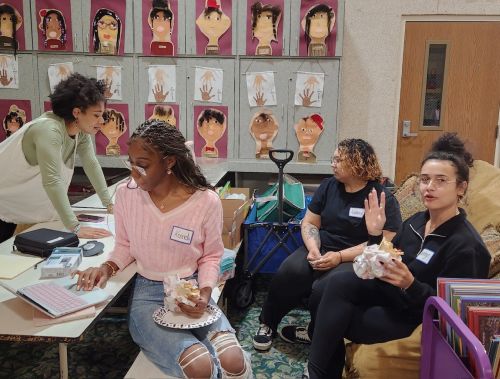
Family Voices student team members Simone Bibbs, Kennedy Perkins, Anneliese Samples, and Audrey Jones prepare to meet with parent and child groups at Pam’s Academy of Champions in Lansing.
Listening to people in communities is crucial to identifying the most pressing problems facing marginalized youth and their families, said Smith, who also serves as Editor-in-Chief of the American Journal of Community Psychology. For the Family Voices project, she collaborated with Pam’s Academy of Champions in Lansing, the YMCA of Metropolitan Lansing, and MSU’s Child Development Lab to host focus groups.
“We gather together groups of elementary school-age children and their parents. We literally make time to listen to the issues that they see are most pressing, to hear them,” Smith said. Children had an opportunity to express themselves through art as part of a project led by an MSU graduate and undergraduate student. A high school student also participated.
Hearing directly from the children was especially powerful, Smith said. “Even though they are elementary schoolchildren, they were very forthright telling us about the kinds of institutional racism they receive in school, ranging from microaggressions to literal acts of racism—and the kinds of things their parents teach them about managing that.”
Children described ways their families validated their emotions, providing warmth and support to help them cope. They might take the children out for ice cream or take a walk, for example.
Angela Stepter, a health advocate in Lansing who teaches at the YMCA, facilitated separate focus group sessions with parents. “My biggest takeaway from each session was how important people felt their voice was,” she recalls. Adult participants expressed a desire for more resources to help them support their children, but also for dealing with stress, mental health issues, and economic hardship, she said.
As she facilitated the parents’ group, Stepter was reminded of her and her daughter’s experiences of bullying in sixth grade. As a parent, Stepter notes, she could not prevent these incidents from happening. But she prepared her daughter by emphasizing “nobody’s better than you, and you’re not better than anybody.”
Supporting Children and Families
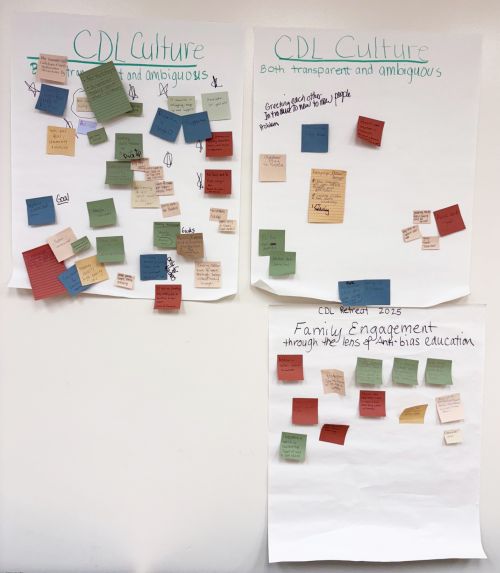
The Family Voices team presented their research as part of a staff retreat at the MSU Child Development Lab.
MSU’s Child Development Lab (CDL) served as a site for focus groups. CDL offers full-day preschool programs for children from birth to kindergarten at its East Lansing campus and part-time programs for children age 3 to kindergarten at its Haslett campus.
CDL serves a diverse community and places a strong emphasis on anti-bias education, said director Laurie Linscott. “It starts early with our infants and toddlers,” she said. She invited Smith to present on her study because “it really does and continues to inform the work we do here.”
The voices of children were “a stark reminder of what can be the reality for children of color even in elementary school,” Linscott said. “We like to think those days have passed. If anyone had blinders on, you have to take them off after that research.”
One outcome of the findings is a continued emphasis on anti-bias education that focuses on identity, diversity, advocacy, and social justice, Linscott said. For the staff and student teachers at CDL, Smith’s research underlined the importance of engaging families to better understand the realities of their lives.
Smith noted that schools and after-school settings “have a transformative role” and can enact programs to prepare children in advance to deal with racialized bullying and implement appropriate disciplinary practices.
In addition to grappling with racism, many racial-ethnic minority families “are disproportionately affected by things like poverty and economic hardship and stress due to living in under-resourced communities with less economic opportunities,” Smith said.
Those themes came through repeatedly during the focus groups with family members, Stepter recalled. While they appreciated being heard, many would like to see more community resources focused on stress, mental health, and financial literacy and entrepreneurship.
The Work Continues
To help families and children navigate these stresses, one outcome of the research could involve collaboration with MSU Extension, which serves the state’s 83 counties, Smith said. MSU Extension offers parenting classes but can also be a resource to assist families with debt reduction, home ownership, and financial literacy, she said.
Smith and her team plan to continue their work with and for marginalized youth and families, even in today’s tenuous funding environment. She recently called together colleagues to discuss challenges and exchange ideas on how to continue their research.
Meantime, she is buoyed by “the beautiful people I encounter, the people who say ‘Oh, we’re setting up family centers. We’re working in after-school programs. We are helping people to be fit and well. And we’re doing it no matter what.’ That gives me joy.”
- Written by Patricia Mish, University Outreach and Engagement
- Photographs courtesy of Emilie Smith