From East Lansing to Skopje:
Students Combat Climate Change through Theatre and Dance
- Deric McNish, Ph.D.
- Associate Professor, Department of Theatre
- College of Arts and Letters
- Rob Roznowski, MFA
- Professor, Department of Theatre
- College of Arts and Letters
Project Overview
- A cross-cultural performance project brought together young people from MSU and North Macedonia to create original theatre and dance to address climate change.
Products/Outcomes
- A performance called The Ripple Effect allowed students from MSU and North Macedonia to gain insights about each other’s cultures and the impact of climate change in both regions.
- MSU students learned about movement and dance, exploring new ways of storytelling through the body.
- Students from North Macedonia gained exposure to devising techniques such as scripting and character exploration.
- The Ripple Effect led to smaller-scale collaborations in Spain and Greece.
Partners
- Gorjan Jovanovski, eco-activist, North Macedonia
- Bojan Lazarov, Bullfrogs Ballet, North Macedonia
- Aleksandra Nikiforovski, Bullfrogs Ballet, North Macedonia
- Amber Pearson, MSU Water Alliance member and professor of public health
- U.S. Department of State
Form(s) of Engagement
- Community-Engaged Research and Creative Activities
- Community-Engaged Teaching and Learning
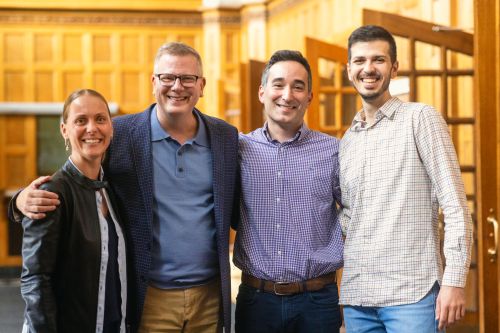
Faculty from the MSU Department of Theatre and Bullfrogs Ballet in North Macedonia exchanged expertise during residencies in both countries. From left: Aleksandra Nikiforovski, Rob Roznowski, Deric McNish, and Bojan Lazarov.
Six hours and nearly 5,000 miles separate East Lansing and Skopje, North Macedonia.
But neither time nor distance hindered Michigan State University faculty and students and their Macedonian counterparts from collaborating on a theatre project that addresses their shared concerns about climate change.
Funded by a grant from the U.S. Embassy in North Macedonia, the project paired Deric McNish and Rob Roznowski of MSU’s Department of Theatre with Bullfrogs Ballet, a school of dance in North Macedonia.
Together they produced The Ripple Effect, a performance that brings together diverse theatrical techniques and dance to explore the theme of climate justice from the perspectives of U.S. and Macedonian students.
“At its core, it’s a cross-cultural performance project to help young people co-create original theatre and dance to combat climate change,” McNish said.
Theatre ‘From the Ground Up’
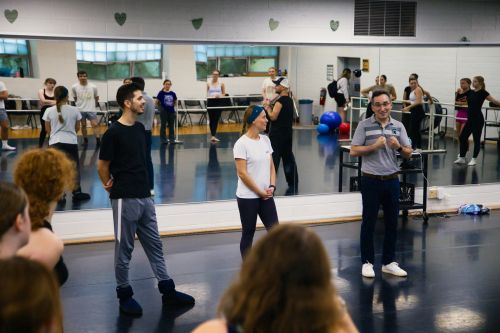
Bojan Lazarov, Aleksandra Nikiforovski, and Deric McNish work with students in the MSU dance studio.
McNish, an associate professor of theatre and director of undergraduate research in the College of Arts and Letters, and Roznowski, a professor of theatre, connected with Bullfrogs Ballet through a contact of Roznowski’s. The partnership emerged from a shared interest in collaborative theatre that brings together different artistic and cultural voices.
“Both of our institutions believe deeply in the power of collaboration, in learning from each other, and in exploring new techniques that push the boundaries of performance,” said Bojan Lazarov, actor, dancer, choreographer, and an external collaborator with Bullfrogs Ballet School. “This project is also a great opportunity to open doors for new knowledge, to exchange ideas on a global level, and to build a foundation for future collaborations.”
Founded in 2009 by Aleksandra Nikiforovski, Bullfrogs Ballet is a nongovernmental organization that encourages artistic expression among young people through dance classes and productions that often explore social issues.
Roznowski and McNish found Bullfrogs Ballet to be an ideal partner. “Both of us really love the form of devising, which is theatre created from the ground up by community,” Roznowski said. Added McNish, “The act of devising is collaborative, creating a piece between two separate groups where everyone has an artistic voice.”
The project also gave MSU students and their counterparts in North Macedonia an opportunity to exchange and share their perspectives on climate change. “Our students gained not only new techniques in theatre and dance, but also a deeper understanding of how environmental issues affect people in both communities,” said Lazarov. “Working side by side, they explored mutual solutions, built empathy, and developed a broader perspective on how art can be a tool for change.”
Bojan Lazarov demonstrates dance movements during a residency at MSU.
A Cultural Exchange
On MSU’s side, participants included 10 theatre majors and 20 Integrative Arts and Humanities students in an IAH course co-taught by McNish and Roznowski. Over several Zoom sessions, the MSU group met with the Macedonian students to learn about each other’s experiences of climate change, cultural contexts, and approaches to theatre.
“It was a beautiful experience,” said McNish. “The first collaborative moment was when everybody came together.” During those early interactions, students shared their perspectives, stories, and assumptions. They asked deeper questions, like whether they felt empowered to protest or make societal changes.
Amber Pearson, a professor of public health and part of the MSU Water Alliance initiative, spoke about challenges facing the Great Lakes. Gorjan Jovanovski, an eco-activist in North Macedonia who created an app that measures climate change locally, spoke about air and water pollution there.
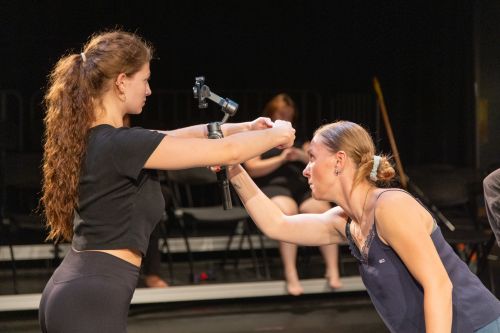
Aleksandra Nikiforovski, founder of Bullfrogs Ballet, works with MSU students to film and choreograph scenes for The Ripple Effect.
As part of the class, McNish and Roznowski challenged their MSU students to come up with scenes or vignettes related to what they learned from the climate experts and their Macedonian counterparts. A similar dynamic played out in North Macedonia.
The collaboration deepened as the students from both countries met regularly via Zoom. As the semester progressed, McNish and Roznowski visited North Macedonia, and Lazarov and Nikiforovski came to MSU. The MSU professors lent their expertise in devising and acting, while the Bullfrogs Ballet team offered master classes on movement and dance.
“When they came to us, they taught traditional North Macedonian dance, and they shared their very embodied way of telling stories,” said McNish. “When we went there, we were sharing our devising techniques—techniques more based on scripting and the psychological exploration of character.”
In North Macedonia, Roznowski found it especially rewarding to hear personal stories from students about how climate change affected them and their families. “And then taking that story and working with other people to bring it to life is a big act of trust . . . that was a really meaningful moment,” he said.
The artistic and cultural exchange came to life in theatrical productions of The Ripple Effect—one at MSU and the other in Skopje, North Macedonia. “Each of those were informed by the other in lots of different ways,” said McNish, noting that the stories themselves and their expression reflected both cultures and approaches to theatre.
“Together, we created original movement pieces for the final performance, blending our approaches and artistic languages into something unique and powerful,” said Lazarov, who directed the North Macedonia performance.
Continuing Collaborations
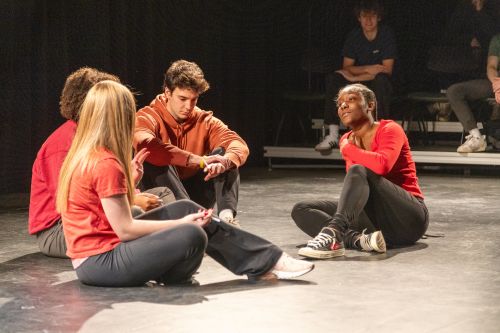
MSU students perform in The Ripple Effect, which explored threats to the environment in both the United States and North Macedonia.
The collaboration did not end with the curtain call. After traveling to North Macedonia, McNish and Roznowski did “mini-residencies” in Spain and Greece to collaborate on theatre productions based on climate issues facing people in coastal versus noncoastal villages.
Last summer, using funding from a separate U.S. State Department grant, the two hosted an exchange program on collaborative storytelling that brought 21 English-language theatre educators from around the world to MSU.
The focus was not specifically on climate change, but the collaborations in North Macedonia, Spain, and Greece informed their approach to making intercultural connections through theatre, McNish and Roznowski said. “I think that we’re particularly sensitive to different perspectives, and I think we’ve become good at nurturing those and helping people share those stories,” McNish said. The program focused on bringing new approaches such as devising and collaborative storytelling into international classrooms.
The two hope to continue their work with Bullfrogs Ballet in North Macedonia, and they along with Lazarov are seeking funding externally and from within MSU. They also made additional connections last summer to potentially expand the work to other countries.
Lazarov expressed confidence that The Ripple Effect will live up to its name. “We not only created a meaningful performance in the USA and North Macedonia around an urgent global issue, but we also built a strong collaborative network,” he said. “The experience broadened everyone’s creative horizons and demonstrated how much can be achieved when artists from different cultures come together with a shared purpose.”
- Written by Patricia Mish, University Outreach and Engagement
- Photos by Ryan Frederick