Mindfulness Activities Set Young Children on Path to Healthier Lives
- Jiying Ling, Ph.D., RN, FAAN
- MSU Research Foundation Professor
- Assistant Director of Ph.D. Program
- College of Nursing
Project Overview
- The Food-Body-Mind Intervention explores the mental, emotional, behavioral, and physical health of low-income families participating in rural and urban Head Start organizations across Michigan.
- To promote whole child health, the research project combines tools to help children navigate life changes and emotions, while encouraging healthy eating habits and physical activity.
Products/Outcomes
- Early findings suggest promising improvements in young children’s mental, emotional, and behavioral health.
- Children are bringing lessons learned in the classroom home and continuing to practice healthy eating habits and breathing exercises with their families.
Partners
- Kimberly Arcoleo, College of Nursing
- Capital Area Community Services, Inc.
- Renee Clark, Head Start teacher
- Community Action Agency
- Tsui-Sui Annie Kao, College of Nursing
- Jean Kerver, College of Human Medicine
- MiSide
- New St. Paul Head Start Agency
- Northeast Michigan Community Service Agency
- Northwest Michigan Community Action Agency
- Kenneth Resnicow, University of Minnesota
- Lorraine Robbins, College of Nursing
- Charis Lauren Wahman, College of Education
- Nanhua Zhang, Cincinnati Children’s Hospital Medical Center
Form(s) of Engagement
- Community-Engaged Research
- Community-Engaged Teaching and Learning
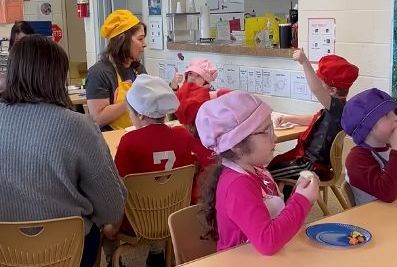
Head Start teacher Renee Clark sits with her students while sampling a variety of fruits and vegetables as part of Jiying Ling’s research project called Eat My ABCs.
Wednesdays in Renee Clark’s classroom were days her 4- and 5-year-old students eagerly awaited. They put on chef’s hats, tied their aprons, and proudly displayed official “taste tester” stickers as they prepared to sample a variety of fruits and vegetables.
The taste test was part of a research project called Eat My ABCs: Integrate Healthy Eating into School Readiness, developed by Jiying Ling, an MSU Research Foundation Professor in the College of Nursing.
Ling’s interest in healthy child development dates to 2014 when she connected with parents and teachers from the Capital Area Community Services organization inquiring about socioeconomic stressors they were facing. A common theme arose: the need to address obesity, promote healthy eating, and increase physical activity.
With a $250,000 grant from the Michigan Health Endowment Fund, Ling began her research seeking to improve the eating behaviors of Head Start students. This pilot study took place over 14 weeks. Head Start teachers received healthy eating educational materials, which families could then use to support eating behavioral changes at home.
Along with her focus on healthier habits, Ling witnessed firsthand how the pandemic affected children. With fewer opportunities to interact with peers, young children struggled to develop social skills, which often led to behavioral challenges.
“I was interested in combining tools to help manage negative emotions and life changes while incorporating the importance of understanding the benefits of healthy eating and physical activity,” Ling said.
Whole Child Health
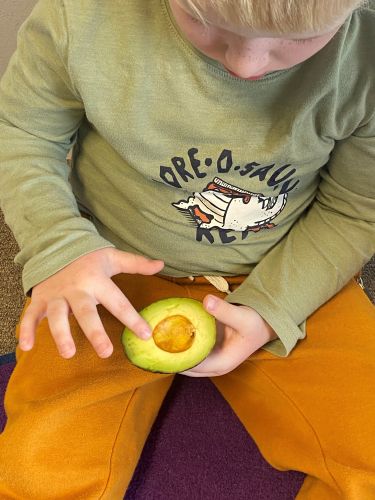
Students are learning to build healthy relationships with food to better understand how their bodies respond to what they’re eating.
Guided by her prior research, lived experiences, and commitment to promoting overall health, Ling designed the Food-Body-Mind Intervention: Promote Whole Child Health, in collaboration with students, parents, and teachers. Her study explores the mental, emotional, behavioral, and physical health of hundreds of low-income families participating in rural and urban Head Start organizations across Michigan. Her goal is to equip children and their families with the knowledge and skills they need to live healthier lives.
In 2023, Ling received a $5.8 million grant from the National Institutes of Health to carry out her study. It was the largest single-researcher grant in the 73-year history of the MSU College of Nursing.
Building on the strong relationships she had established with Head Start teachers in earlier studies, Ling and her team conducted face-to-face meetings with parents and made themselves available to talk to them during school drop-off and pickup times. She outlined the purpose, benefits, and goals of the program, emphasizing the importance of engagement and participation by parents.
The pilot trial, which began in February of 2024, resulted in 50 Head Start programs joining the 16-week program as part of a five-year study.
Eating and Walking My ABCs
Each teacher was given digital access to the two-part curriculum, along with additional materials to ensure lesson delivery was seamless and consistent.
“From a participating teacher’s perspective, the study was an all-inclusive package,” Clark said. “We were given the curriculum, accompanying materials, and the opportunity to earn monetary cards. One of the first things we did was buy the chef’s hats, aprons, and taste tester name tags. The lovely thing about preschoolers is if you make something exciting, they’re jumping on board with it,” she said with a smile.
The first part of the program, “Eat My ABCs,” is designed to help students build healthy relationships with food and understand how their bodies respond to what they’re eating. Over several weeks, students sampled 32 different fruits and vegetables, each correlating with a letter in the alphabet.
“Let’s say the first week we were focusing on the letter ‘A.’ We would talk about fruits and vegetables that started with ‘A’ and taste test them,” Clark said. “It brought mindfulness into eating because we would take a test bite together and talk about how we chew our food, how it feels in our mouths, and how it feels in our tummies.”
Clark noted that there were many picky eaters in her classroom, but even the most hesitant tried new things. Ling acknowledged the beginning of the program can be challenging, but said the tentativeness is part of the process. “We want students to try foods they’re both familiar and unfamiliar with, while reminding them that it’s ok to try something new,” she said. “After the first few weeks of repeating the same routine, they get used to it and are more open to tasting new foods.”
Teachers worked to ensure lessons learned in the classroom continued at home. Each student took home a letter detailing the foods they had tried, where they could place stickers indicating what they liked, didn’t like yet, and what they wanted to try at home. Clark noted that parents were excited to report that their children were more willing to try new foods at home and were even asking for vegetables rather than less healthy alternatives.
“We don’t tell them to avoid things like sweets because we don’t want to fill their minds with unnecessary judgments,” Ling said. “We want them to eat the food they enjoy but remind them of the importance of balanced meals and to listen to their body’s responses to what they’re eating.”
Parents, who had mentioned being cautious about buying certain vegetables in the past due to food and money waste, said their children were now eating more fruits and vegetables at home.
Clark said Ling and her team had the right combination of parents, classroom involvement, and incentives. “By providing monetary gift cards to teachers and participating parents, we were able to buy the aprons and chef’s hats, and parents were able to purchase extra food for their household and even birthday presents for their kids.”
The second part of the program, “Walk My ABCs,” focuses on bringing mindfulness into movements and moments.
“Our goal is to equip children from low-income families with the resources to manage their emotions during life’s challenges,” Ling said. “Families have a lot of stressors, so providing them with supports that are easy and simple, we can teach them to think before they react.”
Young learners taste-test fruits and vegetables with their teacher.
To begin this process, students engaged in physical activities, like jumping jacks, and then reflected on how their bodies responded to this movement. They noted that their bodies were warmer, and their breathing was faster. They were then asked to think about how their bodies reacted when they felt scared or angry.
Following the intense activity, students shifted to yoga poses and focused on breathing and stretching. When asked again how their bodies felt, they described the sensations as “peaceful” and “calming down.”
Ling explained that children can struggle to describe how they feel with words, so they often resort to expressing anger or frustration through hitting or crying. Learning to manage their emotions can help them articulate how and why they are feeling a certain way.
“Sometimes we experience negative emotions, but by teaching the students what they can do before they react by counting and taking deep breaths, they can better navigate their reactions,” Ling said. “During this exercise, they’re encouraged to say something positive to themselves. Students shared phrases like, ‘I’m loved, I’m strong, I’m allowed to feel,’ which helps reinforce positivity and improve self-confidence when they encounter big emotions.”
Once children learn how to manage negative emotions, their social skills improve, allowing them to interact with their peers more mindfully and peacefully, which, in turn, helps reduce problem behaviors and better their mental health, Ling said.
Parents also reported that their children were bringing the yoga and breathing lessons home. When someone in the family felt upset, their child would say something like, “Let’s take a couple of deep breaths together,” Ling said.
“Kids are teaching their parents, and parents naturally value what their children share,” Ling said. “Hearing something from their child can carry more influence than hearing it from a teacher or faculty member.”
‘A Foundation for Healthier Communities’
The study has grown to include 400 low-income parent-child pairs across rural and urban day care centers. Early findings suggest promising improvements in young children’s mental, emotional, and behavioral health. With a wider set of data, the potential for long-term sustainability grows, expanding to other day care programs across the country.
Ling shared the encouragement and appreciation she and her team are receiving from teachers who are experiencing the benefits of their students participating in the program. She noted one teacher expressed that she was hopeful her organization would continue the program indefinitely.
In an Instagram video by the College of Nursing, Clark said, “I am trying to help build a foundation for healthier communities for children and families.”
Ling shares that sentiment and is continuing her work with Head Start to build a foundation for lifelong mental, emotional, and behavioral success.
- Written by Emily Springer, University Outreach and Engagement
- Photographs courtesy of Jiying Ling